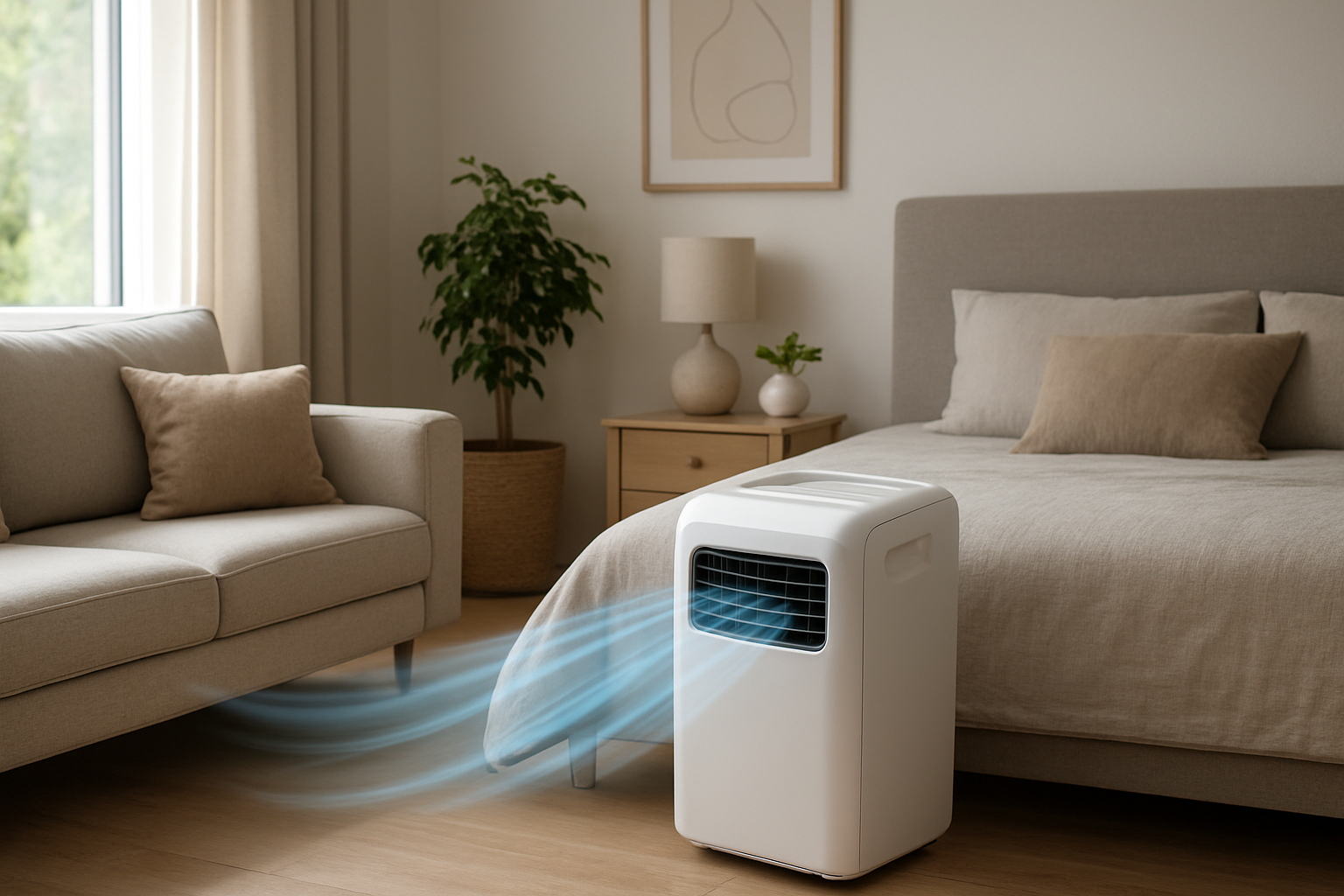
Diagnose why your portable AC blows air but fails to cool, focusing on insufficient cooling capacity compared to the room’s heat load and possible solutions.
Portable AC Blows Air But The Room Stays Warm? Here’s The Cause
Quick Answer
If your portable AC is blowing air but the room stays warm, the most likely cause is insufficient cooling capacity for the room’s real heat load. First check: close the door, block sun with blinds, and run the unit on max cool for 60–90 minutes. If room temperature barely drops (about 2–4°F), the space load is outrunning the unit.
Identify the Comfort Pattern First
Before assuming the unit is broken, sort the symptom by pattern. Capacity problems have a specific signature in real homes.
Time of day: Works better in the morning or at night, then loses the battle mid-afternoon when outdoor temperature and sun load peak.
Weather dependence: Comfortable on mild days, weak cooling on hot/humid days even though the unit runs constantly.
Room size and openness: Cools a small closed room better, struggles when the door is open to a hallway, kitchen, or open-plan area.
Constant vs intermittent: Runs nearly nonstop without reaching the set temperature. Limited cycling is a classic capacity mismatch clue.
Door closed vs open behavior: With the door closed the room slowly improves; with the door open the temperature hardly changes.
Vertical differences: Cooler air near the floor but warm, stagnant air at head height or near the ceiling; warm ceiling indicates heat load and stratification overpowering mixing.
Humidity perception: Air may feel less sticky near the unit, yet the room still feels warm overall. High humidity load can consume capacity and keep comfort poor even with some temperature drop.
Airflow strength: Strong airflow from the outlet does not guarantee cooling capacity. A unit can move plenty of air while still not removing enough heat from the space.
What This Usually Means Physically
A portable AC only does one job: remove heat from the room and reject it outside through the exhaust hose. When the room stays warm, it usually means the heat entering the room is greater than the heat the unit can remove.
In the field, the most common reason is capacity mismatch: the unit’s effective cooling output is lower than the room’s combined heat load from:
Solar gain: Sun through windows can add a large, steady load, especially west- and south-facing glass in the afternoon.
Conductive heat gain: Heat flowing through under-insulated walls/ceilings or a hot attic above the room.
Infiltration and door traffic: Warm, humid outdoor air leaking in around doors, windows, or from a leaky return path to the rest of the home.
Internal gains: People, cooking, electronics, and lighting adding heat right where you are trying to cool.
Humidity load: If indoor air is humid, the unit spends a significant portion of its capacity condensing moisture rather than dropping air temperature.
On top of that, portable units often deliver less real cooling than homeowners expect because:
Single-hose designs depressurize the room: Exhausting indoor air pulls warm outdoor air in through cracks, creating an ongoing heat and humidity penalty.
Long, kinked, or hot exhaust routing raises backpressure: Poor heat rejection makes the unit less effective even if it is mechanically fine.
Short-circuiting air paths: Exhaust heat recirculating near the intake or hose heating up the room can erode net cooling.
Most Probable Causes (Ranked)
Cooling capacity too small for the real heat load (most common): Unit runs continuously, room temperature improves only slightly, and performance is much better at night or in a smaller closed room.
High solar gain through windows: Room heats up rapidly when sun hits the glass; blinds open equals much worse comfort; the area near windows feels hottest.
Single-hose negative pressure pulling hot outdoor air inside: Room feels drafty at door gaps; cooling is noticeably better when a window/door crack is sealed well and the room is kept tightly closed.
Exhaust hose losses (too long, crushed, leaking, or uninsulated through a hot area): Hose is extremely hot to the touch; air near the hose feels warmer; cooling improves when the hose is shortened/straightened.
Humidity load consuming capacity: Room feels clammy, temperature drop is modest, and comfort improves more in dry weather than humid weather.
Air bypass or filter restriction reducing effective heat exchange: Airflow may still feel strong, but cooling weakens over days/weeks; filter is loaded or the intake is blocked by curtains/furniture.
How to Confirm the Cause Yourself
These checks focus on observable results, not tools or disassembly. They are designed to confirm a load-versus-capacity problem.
Closed-room isolation test: Close the door to the room, close nearby doors and windows, and run the unit on max cool for 60–90 minutes. If comfort improves clearly only when the room is isolated, the unit is undersized for any larger open area.
Time-of-day load test: Note room comfort at 9–11 a.m. vs 3–6 p.m. If it keeps up earlier but loses ground in peak sun/heat, that points to heat load exceeding capacity rather than a sudden mechanical failure.
Sun control test: Fully close blinds/curtains and keep the unit running. If the room becomes noticeably easier to cool within an hour compared to the same time on a sunny day, solar gain is a primary driver.
Door crack and draft check: With the portable AC running, feel for incoming warm air at the bottom of the door and around window frames. A noticeable inward pull suggests negative pressure makeup air is being dragged in, which increases heat and humidity load.
Exhaust routing check: Ensure the hose is as short and straight as possible, not kinked, and not leaking at connections. If the room cools better after straightening/shortening, heat rejection was compromised and effective capacity was reduced.
Humidity indicator check: If the room feels significantly less sticky after sustained operation but still not cool, the unit may be spending capacity on dehumidification. That is still a capacity issue relative to load, not necessarily a defect.
Target zone check: Sit 6–10 feet from the unit, away from windows, and compare perceived comfort to the rest of the room. If the immediate area is acceptable but the room average is not, the unit is underpowered for total load or the room has strong hot spots (often window/ceiling load).
Normal Behavior vs Real Problem
Normal behavior: In high heat, a portable AC may run continuously and still take 30–90 minutes to make a noticeable difference, especially in an upstairs room or one with sun exposure. Some warm-to-cool zoning is normal: cooler near the unit and warmer near windows or the ceiling.
Real problem indicators: Room temperature does not trend downward over 60–90 minutes with the door closed; comfort collapses every sunny afternoon; the unit only cools if the room is much smaller than intended; or the space becomes less humid but stays warm even under modest outdoor conditions. These patterns typically indicate that net capacity delivered to the room is insufficient compared to heat and moisture entering.
When Professional Service Is Needed
Call for service or replacement guidance when any of the thresholds below are met:
Persistent performance loss: The unit used to cool the same room and now cannot, even at night with the door closed.
No measurable cooling trend: After 90 minutes in a closed room with blinds closed, the space remains essentially unchanged in comfort and the unit never seems to “catch up.”
Suspected installation defect you cannot correct: Exhaust adapter won’t seal, hose must be excessively long, or the window kit cannot be made tight enough to prevent makeup air issues.
Water or icing abnormalities: Repeated icing, unusual water leakage beyond minor condensate handling, or the unit shutting down frequently on faults.
Severe comfort impact: The room remains hot enough to disrupt sleep or occupancy despite following isolation and sun-control steps.
How to Prevent This in the Future
Match capacity to the real load, not just square footage: Rooms with strong sun, top-floor ceilings, or leaky windows need more capacity than a shaded interior room of the same size.
Control solar gain first: Use blackout shades, reflective window coverings, or exterior shading during peak sun hours to reduce the load the AC must remove.
Keep the conditioned zone small: Treat a portable AC as a spot/room unit. Keep doors closed and limit air exchange with warmer parts of the home.
Optimize exhaust: Keep the hose short, straight, and well-sealed at both ends. Avoid routing near heat sources and avoid slack loops that radiate heat back into the room.
Reduce internal heat: Minimize cooking, high-watt lighting, and heat-generating electronics during peak hours in the same room.
Maintain intake paths: Keep filters clean and keep curtains/furniture from starving the intake, which reduces delivered capacity.
Related Home Comfort Symptoms
Portable AC runs constantly and never reaches set temperature
Room cools at night but not during the afternoon
Upstairs bedroom stays hot with AC running
Air feels less humid but still too warm
Cool near the unit but hot near the window or ceiling
Conclusion
When a portable AC blows air but the room stays warm, the most probable explanation is insufficient net cooling capacity relative to the room’s heat and humidity load, often amplified by solar gain and portable-unit exhaust penalties. Confirm it by isolating the room, blocking sun, and observing whether the space temperature and comfort trend downward over 60–90 minutes. If it only works in a smaller closed zone or only at night, treat it as a capacity mismatch and reduce the load or upgrade the solution.
Frequently Asked Questions
Why does my portable AC blow strong air but the room temperature barely drops?
Airflow strength only tells you the fan is moving air. If the room heat load (sun, hot attic, infiltration, humidity, internal heat) is higher than the unit’s effective cooling output, the room will stay warm even with strong airflow and continuous runtime.
Is it normal for a portable AC to run all day?
Yes during hot weather, especially in sunny or upstairs rooms. Continuous operation becomes a diagnostic concern when the room does not improve after 60–90 minutes with the door closed and sun controlled, or when performance is much worse than it used to be in the same conditions.
My portable AC cools at night but not in the afternoon. What does that indicate?
That pattern strongly indicates capacity versus load. Afternoon solar gain through windows and higher outdoor temperatures increase heat entering the room, pushing the space beyond what the portable AC can remove.
Does a single-hose portable AC make the room hotter?
It can reduce net cooling because it exhausts indoor air and pulls replacement air in through leaks from outdoors or warmer parts of the home. That makeup air adds heat and humidity load, making the unit feel weaker even when it is operating normally.
How much should the room cool in an hour if the portable AC is correctly sized?
In a closed room with blinds closed, you should typically feel a clear comfort improvement within 30–60 minutes. If after 60–90 minutes the room has only a small change and the unit runs continuously, the likely issue is insufficient capacity for the real heat load or excessive heat gain from sun, leakage, or exhaust setup.
Need a complete overview? Visit the full troubleshooting guide here: Read the full guide for more causes and fixes.
There’s a weird sort of mismatch here: the unit is doing its part, yet the space isn’t cooperating. The air movement feels promising, but the temperature outcome tells a different story.
When that tug-of-war settles, everything just feels calmer—less waiting, less wondering, more “oh, that’s why.” It’s the kind of small daily annoyance that can finally stop following you room to room.