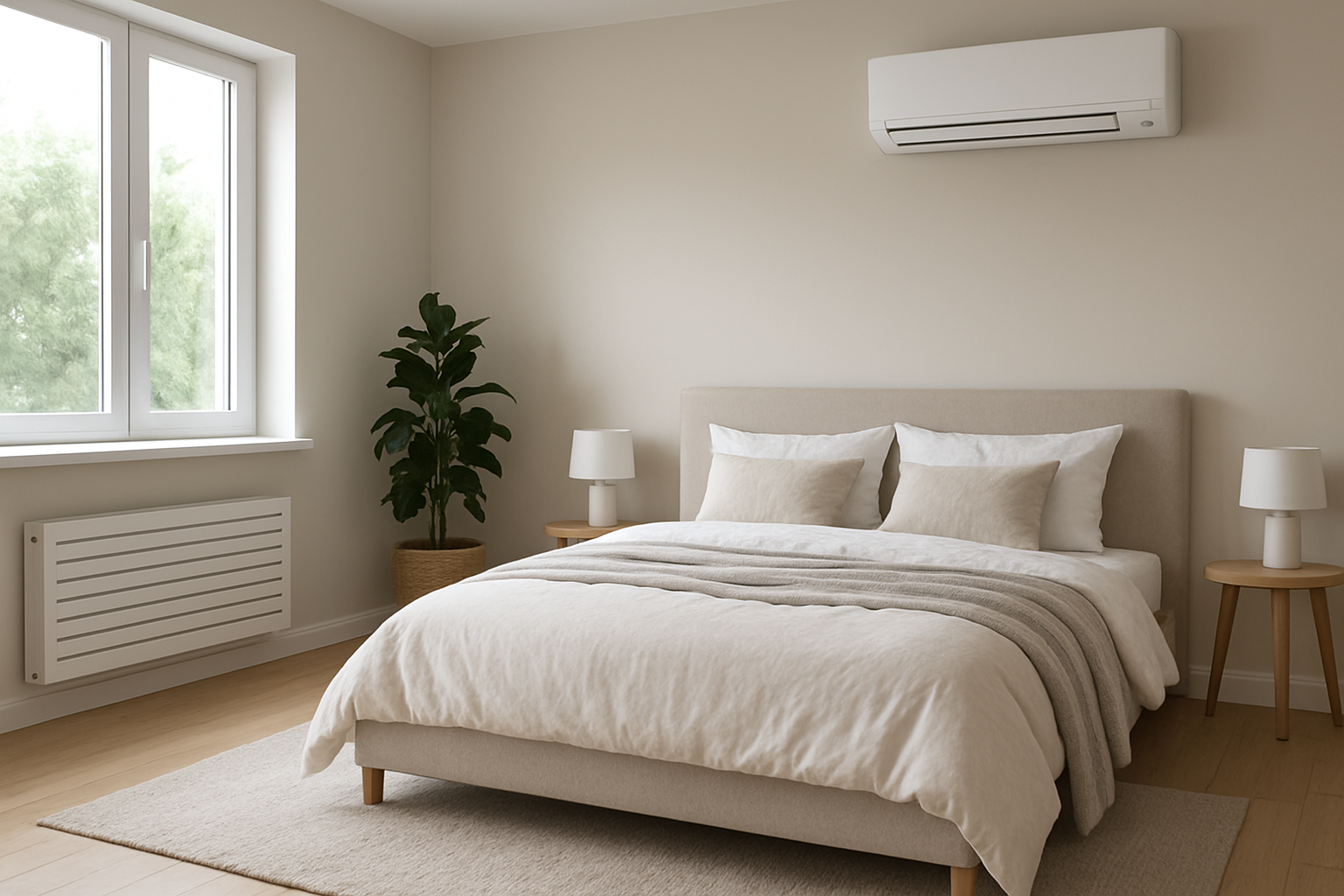
Diagnose uneven bedroom cooling by understanding how air distribution patterns near vents versus the room center affect cooler performance and temperature consistency.
Bedroom Cooler Near Vents Than Room Center? Air Distribution Pattern
Quick Answer
The most likely reason the bedroom feels cooler near the supply vents than in the room center is an air distribution pattern: cold supply air is dropping and short-circuiting along the ceiling or exterior wall instead of mixing with the room air. First check: with the system running, measure temperature at the vent throw path and at the bed height in the room center after 10 minutes of steady operation.
Identify the Comfort Pattern First
Before assuming a fault, sort the symptom into a specific pattern. The pattern tells you whether this is normal air behavior or a distribution problem worth correcting.
When it happens: Mostly during active cooling calls or right after the system starts. If it only happens on the hottest afternoons, solar gain and load are amplifying a mixing issue.
Where it happens: Strongest within 3–6 feet of the supply register, especially if the register is on the ceiling or high wall and aimed across an exterior wall or toward the bed.
System running vs off: If the room center warms noticeably when the system cycles off while the area by the vent stays cool during the run, that points to incomplete mixing (distribution pattern), not a whole-home capacity issue.
Constant vs intermittent: Intermittent cool spot near the vent that appears only during airflow indicates discharge air not blending. A constant center-hot/vent-cold condition across long runtimes suggests poor air circulation or a room load imbalance.
Doors open vs closed: If opening the bedroom door reduces the center-of-room warmth or reduces the cool streak near the vent, the room likely lacks a good return air path, affecting circulation and mixing.
Vertical differences: If the ceiling feels cool while the room center at sitting/bed height stays warmer, you likely have stratification plus a supply jet that stays “up high” or drops directly without spreading.
Humidity perception: If the center feels muggy while the vent area feels dry/cool, you’re sensing two air masses: conditioned air near the discharge and higher-enthalpy room air in the occupied zone.
Airflow strength: A strong blast that feels cold near the register but doesn’t improve the rest of the room often means the air jet is aimed poorly or short-circuiting; weak airflow suggests a restriction that reduces mixing energy.
What This Usually Means Physically
This symptom is typically not a refrigeration problem. It is a mixing problem driven by how supply air enters the room and how the room returns air back to the system.
Cold supply air exits the register as a high-velocity jet. If the jet attaches to a nearby surface (ceiling or wall), it can “ride” that surface due to the Coandă effect, traveling along it instead of dropping into the occupied zone. In many bedrooms, the register throw path runs along the ceiling toward an exterior wall or corner, creating a cool boundary layer near the vent while the room center remains warmer.
At the same time, the room is gaining heat in the center from people, electronics, and solar gain through glass. If the room has a weak return path (door closed with no transfer grille, undercut too small, or blocked return), the supply air has difficulty displacing and mixing the warmer air mass. The result is localized cooling near the vent and incomplete temperature equalization across the room.
In short: the supply air is cold enough, but its distribution pattern is not effectively mixing the room air where you live in the space.
Most Probable Causes (Ranked)
Register throw pattern aimed along a surface, creating a cold streak near the vent: The cool area matches the direction the louvers point; the room center stays warmer even with long runs.
Poor return air path from the bedroom (especially with the door closed): Symptom improves when the door is open; the door may pull or push from pressure when the system starts.
Supply register location too close to a wall/corner or obstructed throw: Vent is near a soffit, curtain, tall dresser, or closet wall; airflow “hits” something and drops without spreading.
Low mixing energy due to reduced airflow at the register: Air feels cold but not forceful; other rooms may have stronger airflow; filter or duct restriction often correlates.
Room load imbalance amplifying distribution limits (solar gain or exterior wall heat): Center-of-room warmth is worst on sunny days or in rooms over garages/with large windows; vent area still cool because discharge air is fine.
Thermostat control not representing the bedroom: Thermostat is in a hallway or different exposure; the system satisfies before bedroom air fully blends, leaving the center warm while vent area is briefly cold during calls.
How to Confirm the Cause Yourself
These checks are observation-based and do not require tools beyond a basic thermometer if you have one.
Two-point temperature check during a steady run: After 10 minutes of continuous cooling, compare temperature at (1) 2–3 feet from the vent in the airstream path and (2) room center at bed height. A difference over about 3–5°F indicates poor mixing rather than a weak cooling system.
Door position test: Run the system with the bedroom door closed for 15 minutes, then repeat with the door open. If the room center becomes noticeably more comfortable with the door open, the return path/air exchange is a primary limiter.
Paper or tissue airflow direction check: Hold tissue near the register to see the primary throw direction. If it clings toward the ceiling or shoots straight at a wall, the jet is likely short-circuiting along surfaces instead of feeding the occupied zone.
Obstruction survey: Look for curtains, blinds, furniture, or a bed canopy within the throw path. If the cool spot is strongest where air hits an object and drops, you’re seeing a collision pattern, not whole-room cooling.
Compare airflow strength to another supply in the home: If this bedroom vent feels much weaker than similar vents, reduced airflow may be preventing mixing. If it feels stronger but still doesn’t cool the center, aim/return path is more likely than restriction.
Time-of-day correlation: If the center stays warm mainly in late afternoon sun, distribution is being overwhelmed by solar gain in the occupied zone while the vent area stays cool because supply air temperature is stable.
Normal Behavior vs Real Problem
Normal behavior: It is normal for the area immediately in the discharge path of a supply vent to feel cooler during active cooling. A slight gradient near the vent (a couple degrees) is expected, especially with ceiling supplies and higher fan speeds.
Likely a real problem: If the room center remains uncomfortable while the vent area is distinctly cold, you have a distribution imbalance. Warning signs include persistent 4°F+ differences across the same room during steady operation, comfort only improving with the door open, noticeable drafts near the vent while the bed area stays warm, or a center-of-room humidity/mugginess feeling during cooling cycles.
When Professional Service Is Needed
Persistent comfort failure: The center of the bedroom stays more than about 3–5°F warmer than the vent area during long cooling calls on multiple days.
Door-dependent comfort: Comfort is acceptable only when the bedroom door is open, suggesting a return path or pressure imbalance that needs correction.
Airflow anomalies: This room has significantly weaker airflow than others or airflow has recently changed, indicating possible duct restriction, damper position issues, or leakage.
System performance decline: Longer runtimes, poorer cooling in multiple rooms, or rising indoor humidity compared to prior seasons.
Noise or icing indicators: Whistling at registers, booming duct noise, or signs of coil/line frosting. These point beyond simple distribution and require service.
How to Prevent This in the Future
Set register direction intentionally: Aim ceiling registers to promote room sweep and mixing, not a direct blast into a corner or straight down onto the bed. Small louver changes can noticeably reduce stratification.
Maintain a return air path: Ensure the bedroom has a practical way for air to leave when the door is closed (adequate door undercut, transfer grille, or dedicated return as designed).
Keep throw paths clear: Avoid placing tall furniture, heavy drapes, or shelving directly in front of the supply discharge.
Keep airflow consistent: Replace/clean filters on schedule and keep supply/return grilles clear so the system maintains the velocity needed for mixing.
Control solar gain where it matters: If the room center heats up from sun, reduce the load with blinds/shades during peak hours; this prevents the center from overpowering the supply distribution pattern.
Related Home Comfort Symptoms
Cold air draft at the bed but the room still feels warm
Bedroom only comfortable with the door open
Ceiling is cool but the room feels stuffy at floor level
One corner of the room is always cooler than the rest
Hallway thermostat reads comfortable but bedroom feels warm
Conclusion
A bedroom that is cooler near the vents than in the room center most commonly points to an air distribution pattern problem: the supply jet is not mixing into the occupied zone, often made worse by a weak return path when the door is closed. Confirm it by comparing temperatures near the throw path versus the room center during a steady run, then repeat with the door open. If the gradient is persistent or door-dependent, correction should focus on airflow routing and return-path pressure, not refrigerant or equipment capacity.
Frequently Asked Questions
Why is it cold right under the vent but warm where I sleep?
The supply air is cold, but it is not mixing through the room. The discharge jet can run along the ceiling or crash into a wall and drop, cooling a small zone while leaving the occupied area dominated by warmer room air and heat gains.
Does this mean my AC is low on refrigerant?
Usually no. Low refrigerant more often shows up as generally weak cooling, long runtimes, rising humidity, or icing. A strong cold spot at the vent with a warm room center is more consistent with distribution and return-path issues.
Why does opening the bedroom door make the temperature more even?
It improves the return air path. With the door closed, the room can become pressure-isolated, reducing effective air exchange and mixing. Opening the door allows supply air to displace room air more easily, reducing stratification and temperature pockets.
How much temperature difference across the room is considered abnormal?
In many homes, 1–2°F variation is common. If you consistently see more than about 3–5°F difference between the vent throw area and the room center during steady cooling, it is typically a correctable distribution problem.
Should I close or partially close the vent to force air to the room center?
Closing a register rarely fixes mixing and can create new issues, including increased noise, higher static pressure, and worse distribution elsewhere. The better approach is adjusting throw direction, clearing obstructions, and ensuring the room has an adequate return air pathway.
Need a complete overview? Visit the full troubleshooting guide here: Read the full guide for more causes and fixes.
By the time the conversation gets to where the air actually lands, the mystery kind of melts away. Near the vent, the bedroom feels like it’s listening; toward the room center, it’s more like the air forgets the assignment.
That small shift is why the temperature can feel inconsistent even when the system is doing its best. It’s the same room, same hours, just a different rhythm—comfort catching up a few steps behind.