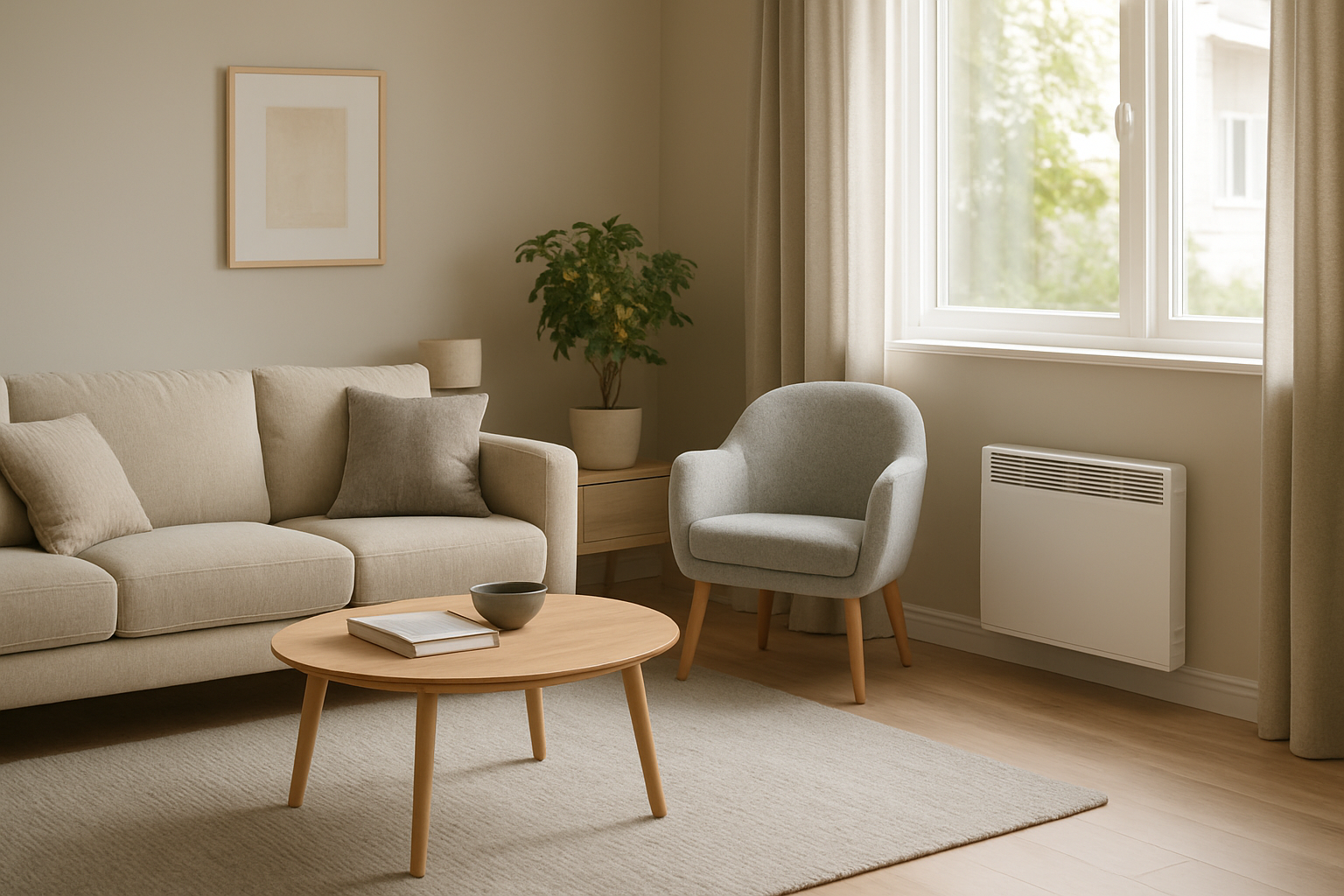
Diagnose why a portable heater runs but fails to warm the room, focusing on convective heating limitations and lack of heat retention in room materials.
Portable Heater Running — But The Room Never Feels Warm
Quick Answer
Most of the time this happens because the heater warms the air briefly, but the room’s surfaces (walls, floor, glass, furniture) never store that heat and keep pulling it back out. First check: measure air temperature at chest height and then touch-test or measure surface temperatures on exterior walls/windows. If surfaces stay cold, you will feel cold even with warmer air.
Identify the Comfort Pattern First
Before blaming the heater, sort the complaint by observable patterns. These point to whether you have warm air without warm surfaces.
When it happens: Worse at night, early morning, and during windy or very cold weather; improves on sunny afternoons even with the same heater setting.
Where it happens: Strongest near exterior walls, windows, over uninsulated floors (over a garage/crawlspace), or in a corner room; less noticeable in interior rooms.
Heater running vs off: The heater runs continuously or cycles normally, but the room still feels chilly; the air may feel warm right in front of the heater yet the rest of the room does not.
Constant vs intermittent: You feel warm for a few minutes after it turns on, then cold again even though the thermostat on the heater hasn’t been reached.
Doors open vs closed: With the door closed, the room can feel stuffy but still cold; with the door open, warmth disappears even faster due to mixing with cooler adjacent air.
Vertical differences: Ceiling feels warm while the floor stays cold; your head is comfortable but feet are cold, especially with fan-forced or radiant panel heaters aimed upward.
Humidity perception: Air can feel dry and “sharp” even when not extremely cold; dryness increases the sensation of cooling at the skin, but the core issue is usually cold surfaces stealing heat.
Airflow strength: Fan heater blows warm air strongly but comfort does not improve away from the heater; infrared/radiant heater feels good only in its line-of-sight.
What This Usually Means Physically
Portable heaters primarily add heat to the air nearby. If the room’s surfaces remain cold, you get a specific failure mode: convective heating without thermal storage in the materials. The air warms, then immediately gives that heat back to colder walls, glass, flooring, and furniture. Your body also loses heat to those cold surfaces by radiation, so the room feels cold even at a measured air temperature that seems adequate.
This shows up most in rooms with high heat loss or low thermal mass temperature:
Heat loss is outpacing input: Exterior walls/windows, air leaks, and poorly insulated floors continuously drain heat. The heater can keep the air warm in a small zone but cannot raise the average surface temperature.
Cold surfaces drive discomfort: If a window is 50–55°F, your body radiates heat to it. You can read 68–70°F air at mid-room and still feel chilled near that window.
Stratification keeps heat off the floor: Warm air rises. Without mixing, the ceiling gets warmer while the lower half of the room (where you live) stays cool, and the floor never absorbs enough heat to feel warm.
Air changes dilute heat: If the room exchanges air rapidly with a colder hallway, attic leakage, or outside infiltration, the heater keeps reheating new cold air instead of warming surfaces.
Most Probable Causes (Ranked)
Cold exterior surfaces dominating comfort (high heat loss through windows/walls): You feel colder near glass/exterior walls; moving to the middle of the room improves comfort more than turning the heater up.
Air leakage and pressure-driven drafts preventing surface warm-up: You notice a constant faint “moving cold” at ankles or around outlets/baseboards; comfort drops when wind picks up.
Floor acting as a heat sink (over crawlspace/garage, slab edge loss): Feet stay cold; rugs help more than increasing heater output; the room is fine from the waist up.
Strong stratification from convective heater placement or no mixing: Ceiling is noticeably warmer than the occupied zone; a small fan aimed to circulate changes comfort quickly.
Heater capacity mismatch for the actual load: Heater runs nearly nonstop and cannot raise room temperature more than a couple degrees above adjacent areas; the room cools rapidly when it cycles off.
Heater thermostat sensing error due to placement: Heater shuts off while the room is still cold, often because it’s sensing a warm pocket of air near the unit; moving the heater changes cycling behavior.
How to Confirm the Cause Yourself
These checks are observation-based and don’t require tools beyond your senses and, if available, a basic thermometer.
Air vs surface check (most useful): After the heater has been running 30–60 minutes, compare the air temperature at chest height in the center of the room to the temperature of an exterior wall or window surface. If the air is much warmer than the surfaces, comfort will lag because the room is not storing heat.
Location test: Stand 1–2 feet from an exterior wall or window, then step to the room center. If you immediately feel warmer away from the exterior boundary, the issue is cold-surface radiation and heat loss, not heater “output.”
Foot-level test: Sit for 10 minutes and pay attention to feet/ankles. If feet stay cold while your upper body is fine, suspect floor heat sink or stratification. Put down a thick rug or foam mat temporarily; if comfort improves noticeably, the floor is absorbing the heat.
Door position test: Run the heater with the door closed for 30 minutes, then repeat with the door open. If open-door operation collapses comfort quickly, the space is not becoming a warmed zone; heat is being diluted by mixing or the room load is too high to ever warm surfaces.
Mixing test (stratification): Run a small fan on low aimed across the room (not directly at you) to circulate. If comfort improves within 5–10 minutes without increasing heater setting, the heater was warming the upper air while the occupied zone stayed cool.
Wind and weather correlation: Note whether comfort drops on windy days or during temperature swings. Strong wind correlation points to infiltration and pressure-driven leakage that prevents surfaces from warming.
Normal Behavior vs Real Problem
Normal behavior: A portable heater warms the air first. In a cold room, it can take hours for thick materials (plaster, masonry, hardwood, large furniture) to come up in temperature. During that warm-up period, the air may read comfortable while you still feel cool near exterior boundaries.
Real problem indicators:
Persistent cold-surface feeling: After 1–2 hours of steady operation, exterior walls/windows still feel markedly cold and the room never becomes uniformly comfortable.
Big vertical split: The ceiling area is warm but the occupied zone remains cool, repeatedly.
Draft-driven discomfort: You can feel moving air at outlets/baseboards or near windows, and comfort changes with wind.
Rapid cool-down: The room loses comfort within minutes of the heater cycling off, suggesting the space is not storing heat and the envelope loss is high.
When Professional Service Is Needed
Comfort remains unacceptable after basic confirmation tests: If a mixing fan improves comfort but the room still cannot stabilize, the room likely has envelope loss, leakage, or distribution issues that need diagnostic tools.
Suspected electrical or heater safety concerns: Tripping breakers, scorching odors, discolored outlets, hot cords, or a heater that runs erratically should be addressed immediately by a qualified professional. Stop using the heater until resolved.
Room cannot maintain temperature relative to the rest of the house: If the space stays 5°F or more colder than adjacent rooms despite continuous heater runtime, you likely have significant heat loss (insulation/air sealing) or a capacity mismatch.
Moisture or condensation appears: Persistent window condensation or damp/cold corners suggest cold surface temperatures and potential hidden air leaks that need on-site evaluation.
How to Prevent This in the Future
Warm the surfaces, not just the air: Give the room a longer preheat period before occupancy, especially for boundary rooms. The goal is raising wall/floor/furniture temperature so the room can store heat.
Reduce cold-surface exposure: Close blinds/curtains at night, add a window insulating layer where appropriate, and use rugs on cold floors to reduce heat sink effect.
Control stratification: Use a low-speed fan to mix the room air gently so heat reaches the occupied zone and surfaces warm more evenly.
Limit dilution: Keep doors positioned intentionally. If the room is meant to be a warm zone, closing the door can help once drafts are controlled. If the room is drafty, address leakage first so closing the door does not just trap cold surfaces with warm air.
Match heater output to the load: If the heater must run continuously to barely hold temperature, focus on envelope improvements (air sealing/insulation) rather than simply increasing heater size.
Related Home Comfort Symptoms
Room air temperature reads warm but you still feel chilled near windows
Warm ceiling, cold floor in a bedroom or office
Space heater makes the air stuffy yet the room feels cold
One corner room never gets comfortable in winter
Temperature drops fast as soon as heat turns off
Conclusion
If your portable heater is running but the room never feels warm, the most likely explanation is that you are only heating the air while the room’s materials stay cold and keep absorbing that heat. Confirm it by comparing air temperature to exterior surface temperatures, checking for stratification, and noting draft or weather correlation. If the room stays significantly colder than the rest of the home or shows draft/condensation patterns, the underlying envelope loss needs professional diagnosis.
Frequently Asked Questions
Why does it feel warmer right in front of the heater but cold everywhere else?
That pattern usually means the heater is creating a small warm-air pocket, but the rest of the room is dominated by cold surfaces and ongoing heat loss. The air warms locally, rises, and gets absorbed by cooler walls/windows before the room can store heat evenly.
My thermometer says 70°F, so why do I still feel cold?
Air temperature is only part of comfort. If nearby surfaces are cold, your body radiates heat to them and you feel chilled even at a normal air reading. This is most noticeable near windows and exterior walls.
Will a bigger heater fix it?
Sometimes, but often it just increases cycling and airflow while the room still struggles to store heat. If the room loses heat quickly through glass, drafts, or an uninsulated floor, reducing the loss and warming surfaces is usually more effective than adding heater capacity.
Why are my feet cold even though my upper body feels okay?
Cold feet typically point to a cold floor acting as a heat sink, or stratification where warm air stays higher in the room. A rug/insulating mat and gentle air mixing are quick ways to confirm this.
Why is it worse at night?
At night, solar gain is gone and exterior surfaces cool down. Those colder surfaces absorb more heat from the air and from your body, so comfort drops even if the heater output hasn’t changed.