Learn how to diagnose and fix thermostat control circuit issues that prevent switching between heating and cooling modes, including common wiring and setting problems.
Thermostat Won’t Switch Between Heat And Cool? What To Check
Quick Answer
Most cases are a mode switching failure in the thermostat control circuit: the thermostat is not sending the correct call to the equipment (or the signal isn’t reaching it). First check: set the thermostat to HEAT, raise the setpoint 5°F, wait 5 minutes, then set to COOL, lower the setpoint 5°F. If only one mode consistently responds, the issue is in the thermostat, wiring, or control board mode inputs.
Identify the Comfort Pattern First
Before touching anything, sort the complaint into a predictable pattern. Mode switching failures have clear fingerprints.
When it happens: Does it fail only during shoulder seasons (mild days needing heat at night and cooling in the afternoon), or does one mode never work any time of year?
Weather sensitivity: Does switching fail after a long run cycle (hot afternoon) or after a power flicker/storm?
System running vs off: Does the thermostat show it is calling (Heat On/Cool On indicator) but the system stays off, or does the equipment run but delivers the wrong output (warm air during COOL or cool air during HEAT)?
Constant vs intermittent: Intermittent switching that works sometimes often points to a loose low-voltage connection or failing thermostat relay; never-working mode points to miswiring, configuration error, or a failed control input.
Where it happens: Whole-house failure points to the thermostat control circuit. If only one area is wrong (one zone), suspect that zone thermostat, zone board output, or damper control, not the furnace/air handler itself.
Changes with doors open/closed: If closing a door makes the room drift badly but switching works, that is airflow/return limitation; if switching itself fails regardless of doors, that is control.
Vertical differences: Large floor-to-ceiling temperature differences (hot upstairs, cool downstairs) can create false impressions that the thermostat is stuck; confirm whether the thermostat is actually changing mode or the home is simply lagging due to stratification.
Humidity perception: Sticky air during “cooling” with little temperature change often means the compressor never started (a control call problem), not that the thermostat refused to switch modes.
Airflow strength: Strong airflow with wrong temperature output suggests the blower is running but the heat/cool stage isn’t being energized (classic mode call failure). Weak airflow points more to airflow restriction than mode switching.
What This Usually Means Physically
The thermostat is a low-voltage switchboard. When you select HEAT or COOL, it routes 24VAC from the R terminal to specific control paths:
Heat call: R to W (or W1/W2) energizes the heating control. The blower may come on after a timed delay or after the heat exchanger warms.
Cool call: R to Y energizes the outdoor compressor contactor (or heat pump compressor), and usually R to G energizes the blower immediately.
Heat pump mode: O/B energizes the reversing valve depending on brand configuration. A wrong O/B setup can make the system feel locked in one mode.
A mode switching failure is usually not the home suddenly changing its load; it is the control circuit failing to deliver the correct signal, or delivering conflicting signals. The indoor comfort result is straightforward building physics:
Heat loss and solar gain keep moving: In spring/fall you may need heat overnight and cooling later. If the thermostat can’t switch, indoor temperature drifts until the house rebalances naturally, which rarely matches comfort.
Air stratification masks performance: If only the blower runs with no heating/cooling engaged, air mixes and may feel like something is happening, but temperature and humidity won’t stabilize.
Humidity load exposes cooling call failures: When cooling fails to energize the compressor, indoor humidity climbs faster than temperature. You feel sticky even if the house is only slightly warm.
Sensor error can mimic control failure: If the thermostat reads wrong, it may never issue the correct call even though mode selection looks correct. That is still a control-circuit outcome: the wrong input (sensor) prevents the right output (mode call).
Most Probable Causes (Ranked)
Thermostat configuration mismatch (most common after replacement): Heat pump vs conventional selection wrong, O/B setting wrong, or staging type mis-set. Clue: system runs but provides the opposite temperature when switching modes, or heat works but cooling never starts (or vice versa) right after install.
Loose or mis-landed thermostat wiring at terminals: A slightly loose Y or W conductor will allow one mode to fail intermittently. Clue: tapping the thermostat or gently wiggling the wall plate changes behavior, or the failure started after painting/renovation.
Thermostat internal relay/contacts failing: Older thermostats can fail to pass 24VAC on one output. Clue: the thermostat display indicates a call, but the equipment never responds in that mode and the issue is consistent.
Control board input problem at furnace/air handler: The W or Y input on the board isn’t being recognized due to a failing board, blown low-voltage fuse, or safety chain interrupt that affects one function. Clue: thermostat appears normal, but equipment response is inconsistent or accompanied by flashing diagnostic codes on the indoor unit.
Heat pump reversing valve circuit problem (O/B not switching): Thermostat may “switch,” but the system remains mechanically in one refrigerant flow direction. Clue: outdoor unit runs in both modes, but supply air temperature is wrong for the selected mode.
Outdoor unit not responding to Y call (contactor/low-voltage break): Appears as thermostat not switching to cool, but the actual failure is the cool signal not reaching or not being accepted by the condenser. Clue: indoor blower runs in COOL, but the outdoor unit is silent.
How to Confirm the Cause Yourself
These checks rely on observation and basic operating behavior. Do not open electrical panels.
1) Confirm the thermostat is actually issuing a call in each mode
Set system to HEAT and raise setpoint 5°F above room temperature. Wait 3–5 minutes.
Observe: Do you see a Heat On indicator? Do you hear the indoor unit start (clicks, inducer fan on a furnace, then blower later)?
Switch to COOL and lower setpoint 5°F below room temperature. Wait 3–5 minutes.
Observe: Do you see a Cool On indicator? Does the indoor blower start quickly? Within a few minutes, does the outdoor unit run?
Decision: If the thermostat indicates a call but nothing happens in only one mode, suspect thermostat output/wiring/control input for that mode.
2) Separate wrong mode from slow house response
After switching to COOL, place your hand at a supply vent after the system has run 10 minutes. Air should feel noticeably cooler than room air.
After switching to HEAT, a vent should feel noticeably warmer than room air once the blower is running.
Decision: If airflow is present but not temperature-shifted, the blower is running without the correct heat/cool stage being energized (control call not being acted on).
3) Watch outdoor unit behavior during a cooling call
In COOL mode with a clear Cool On call, listen outside. A functioning system typically has a steady outdoor fan sound and compressor hum.
Decision: Indoor blower running but outdoor unit silent points away from thermostat mode selection itself and toward a break in the Y circuit path (thermostat output, float switch, safety switch, wiring, or condenser control).
4) Look for short-cycle lockouts or built-in delays that mimic failure
After switching modes, time it. Many thermostats and equipment impose a 5-minute compressor delay. Some heat pumps also delay reversing valve changes during active operation.
Decision: If it always starts after about 5 minutes, that is normal anti-short-cycle behavior, not a mode switching failure.
5) Check for sensor placement effects that prevent mode change
Compare thermostat room temperature reading to a reliable thermometer placed near the thermostat (not in direct sun, not over a register) for 15 minutes.
Note if the thermostat is on an exterior wall, in a sunny hallway, near a kitchen, or above a return grille.
Decision: If the thermostat is off by 3°F or more, it may not be calling for the mode you expect. That can look like it won’t switch when the real issue is poor sensing.
Normal Behavior vs Real Problem
Normal: A 5-minute delay when switching to COOL or after power loss. Many systems protect the compressor from rapid restarts.
Normal: In AUTO changeover thermostats, the thermostat may refuse to switch if the temperature is within the deadband (often 2–4°F) between heat and cool setpoints.
Normal: On heat pumps, a brief period of lukewarm air during mode change or defrost-related events can occur, especially in colder weather.
Real problem: Thermostat indicates Heat On/Cool On but the corresponding equipment never energizes after 10 minutes.
Real problem: System repeatedly delivers the opposite temperature for the selected mode (often O/B configuration or reversing valve control).
Real problem: Only one mode works and it fails consistently, regardless of outdoor conditions or gradual setpoint changes.
When Professional Service Is Needed
Persistent mode failure: One mode does not start after 10 minutes with a clear call and no known compressor delay, especially if the other mode works.
Comfort impact: Indoor temperature drifts more than 4–6°F from your setpoint because you cannot change modes during shoulder-season days.
Performance decline: Blower runs but supply air never becomes meaningfully warm in HEAT or cool/drier in COOL, suggesting control inputs are not being acted upon.
Safety indicators: Burning odor, repeated clicking without start, water around the indoor unit, or an outdoor unit buzzing without running. Also call if the indoor unit is flashing diagnostic codes and the system won’t respond to calls.
How to Prevent This in the Future
Verify thermostat type and programming at install: Confirm it matches your system type (conventional vs heat pump) and that O/B orientation is correct for your equipment.
Keep low-voltage wiring stable: Avoid pulling on the thermostat or wall plate; strain on small conductors is a common cause of intermittent mode calls.
Control humidity to reduce urgent mode switching: When indoor humidity is controlled, you’re less likely to need rapid heat-to-cool swings to feel comfortable during mild weather.
Replace aging thermostats proactively: If the thermostat is older and mode changes have become intermittent, internal relay wear is a practical failure mode.
After power events, observe delays: Give the system a full 5–10 minutes after outages before concluding the thermostat failed to switch modes.
Related Home Comfort Symptoms
Indoor blower runs but no heating or cooling happens
Heat pump blows warm air in COOL or cool air in HEAT
Outdoor unit won’t turn on but indoor fan runs
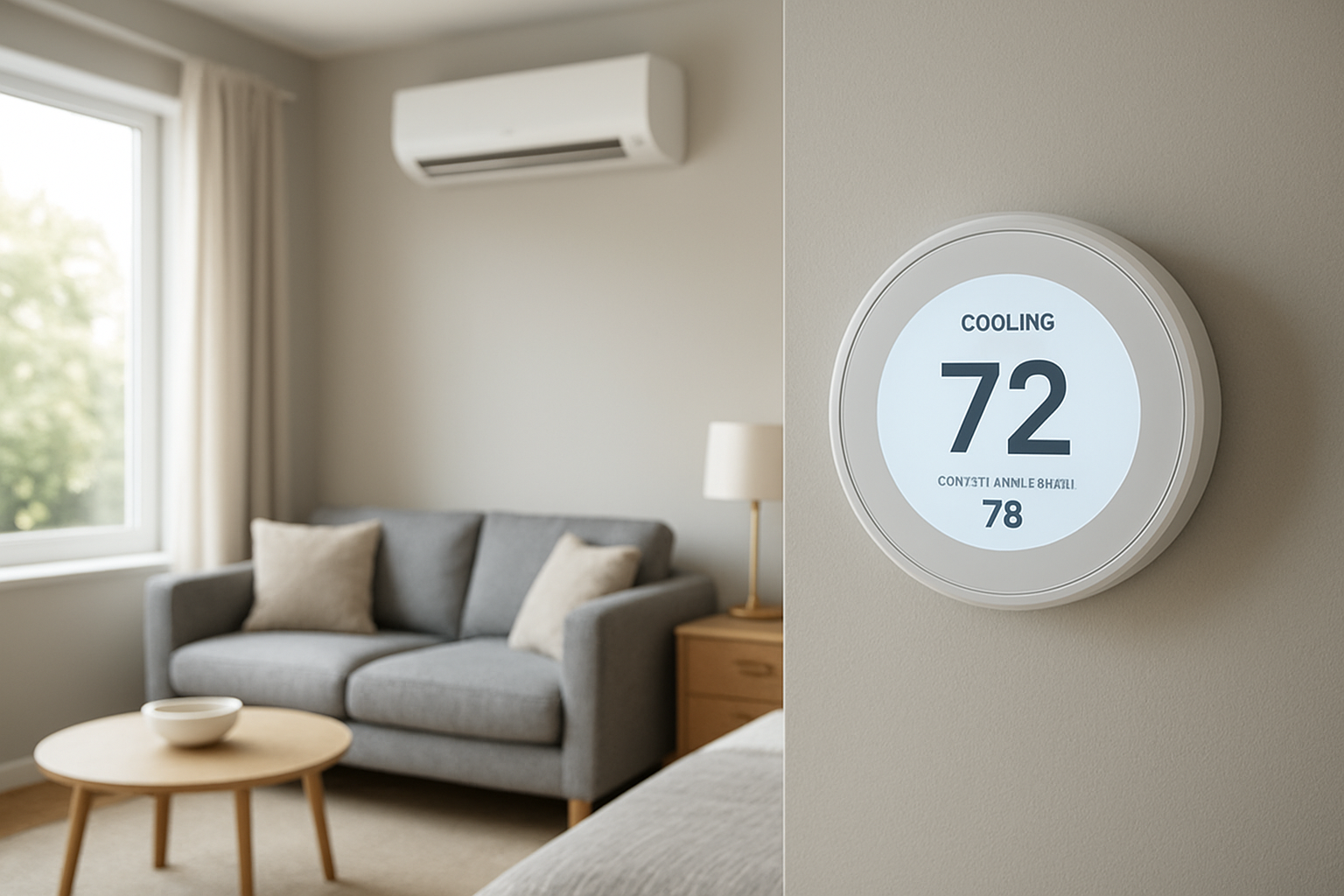
Thermostat says Cooling but house feels humid and sticky
System won’t start after thermostat replacement
Conclusion
If your thermostat won’t switch between heat and cool, the most likely issue is a mode switching failure in the thermostat control circuit: configuration, thermostat output, or the low-voltage signal path to the equipment. Use the mode-call observations (Heat On/Cool On), timing (delay vs no response), and indoor/outdoor unit behavior to pinpoint whether the thermostat is issuing the call and whether the equipment is accepting it. If one mode still won’t respond after 10 minutes, schedule service to test the control circuit safely.
Frequently Asked Questions
Why does my thermostat show Cool On but the air coming out isn’t cold?
This usually means the blower is running but the cooling stage is not energized. In a control-circuit failure, the Y call may not be reaching the outdoor unit, or a safety device may be interrupting the Y circuit. If the outdoor unit is not running while Cool On is displayed, the issue is in the cooling control path, not room airflow.
Can a thermostat delay make it look like it won’t switch modes?
Yes. Many thermostats and outdoor units enforce a 5-minute compressor delay after stopping cooling or after power loss. If cooling starts consistently after a fixed delay, that is normal protection behavior. A true fault is when the system still does not respond after 10 minutes with a clear call.
I have a heat pump. Why does it seem stuck in heat or stuck in cool?
Heat pumps rely on an O/B reversing valve control signal. If the thermostat is configured wrong (O vs B) or the reversing valve control circuit isn’t working, the system can run the compressor but remain in the wrong mode mechanically. The clue is that the outdoor unit runs in both modes, but the supply air temperature matches only one mode.
Why did this start right after I changed the thermostat?
The most common causes are system-type misconfiguration (conventional vs heat pump), incorrect O/B setting, or a mis-landed wire at Y, W, or G. The symptom is typically one mode fails completely or produces the opposite temperature. Rechecking setup and wiring against the equipment type usually resolves it, but do not open equipment panels if you are not trained.
What if switching works sometimes but not always?
Intermittent switching strongly suggests a marginal connection or a failing thermostat output relay. Look for patterns: failures when the thermostat is touched, after temperature swings, or after vibration. If the same mode call occasionally works and then doesn’t, professional testing of the low-voltage circuit is the fastest way to confirm.
Need a complete overview? Visit the full troubleshooting guide here: Read the full guide for more causes and fixes.
There’s a quiet satisfaction in watching the whole system snap into the right rhythm again, instead of doing that stubborn halfhearted shrug between modes. The house finally starts acting like it’s on the same page as you.
Even small control issues have a way of turning into bigger feelings than they deserve, so getting this sorted feels strangely refreshing. Then it’s back to normal life—just with the comfort settings behaving properly.