AC Fan Runs Constantly But Cooling Feels Weak? Fix This
Quick Answer
If the blower fan runs constantly but the house still feels undercooled, the most common explanation is reduced cooling capacity at the coil (often low refrigerant, a dirty indoor coil/filter, or a blower issue) combined with continuous air mixing that hides temperature drop. First check: measure the temperature drop between the return and a nearby supply vent after 15 minutes of cooling.
Identify the Comfort Pattern First
Before assuming a parts failure, sort the symptom. Continuous fan operation with weak cooling has distinct patterns that point to airflow vs capacity vs control problems.
- When it happens: Is cooling weak only during hot afternoons (solar gain peak) or all day and night? All-day weakness points to capacity/airflow limits; afternoon-only often points to load or duct/supply imbalance made worse by constant mixing.
- Where it happens: Whole house warm vs one side/one floor. Whole-house weak cooling suggests system capacity loss or airflow restriction. One area suggests duct issues, zoning problems, or return air pathway problems.
- System running vs off: Does the outdoor unit run while the indoor fan runs? If the fan runs but the outdoor unit cycles off frequently (or never runs), you can feel airflow without real cooling.
- Constant vs intermittent: Fan set to ON means airflow is constant even when cooling is not. Fan set to AUTO should stop between cooling calls. If it runs nonstop in AUTO, suspect a control/relay issue.
- Doors open vs closed: If closing bedroom doors makes those rooms stuffy or warmer, the house likely lacks return air paths, and constant fan circulation exaggerates pressure imbalance and weak delivery.
- Vertical differences: If upstairs stays warm while downstairs is cool, constant fan can reduce natural stratification but cannot overcome insufficient capacity or poor upstairs airflow. Note whether ceilings feel much warmer than the floor.
- Humidity perception: If the home feels clammy even when the thermostat reads near setpoint, constant fan can re-evaporate moisture from the indoor coil between compressor cycles, raising indoor humidity and making cooling feel weak.
- Airflow strength: Strong airflow but weak cooling points toward low cooling capacity (refrigerant/coil/outdoor problem). Weak airflow points toward filter, coil, blower, duct restriction, or dampers.
What This Usually Means Physically
Comfort is not just thermostat temperature. It is sensible cooling (temperature reduction), latent cooling (moisture removal), and how air is distributed.
- Continuous fan mixes air: When the blower runs constantly, it blends warmer air from hot zones (upper floors, sunlit rooms, attic-leaky areas) into the rest of the home. This can make the whole house feel evenly warm instead of having a few hot spots.
- Weak cooling output is typically a coil problem: The indoor coil must be cold enough and have enough refrigerant flow to absorb heat. If it is dirty, starved of refrigerant, or the outdoor unit is not rejecting heat well, the coil cannot deliver the expected temperature drop.
- Airflow and coil temperature must match: Too little airflow makes the coil too cold and can lead to icing and reduced heat transfer. Too much airflow across a marginal coil reduces temperature drop and dehumidification, so it feels like the AC is running but not doing much.
- Humidity load changes comfort: High humidity raises perceived temperature. Constant fan operation between cooling cycles can pull moisture back off the wet coil into the air stream, increasing indoor humidity even if the thermostat number looks acceptable.
- Distribution losses become more obvious: Duct leakage, attic heat gain, or closed-off returns can make delivered supply air warmer by the time it reaches rooms. With the fan always moving air, these losses are always active.
Most Probable Causes (Ranked)
- Fan set to ON causing humidity rebound and comfort loss: Home feels clammy, especially after the compressor shuts off; temperature may be near setpoint but comfort is poor.
- Airflow restriction (dirty filter, clogged return grille, dirty indoor coil): Airflow from vents is weaker than normal; some rooms barely move air; may hear whistling at returns; weak cooling worsens over time.
- Low refrigerant charge or refrigerant flow problem: Airflow feels normal but supply air is not very cold; cooling never catches up on warm days; may see ice on the larger refrigerant line or at the indoor coil access area.
- Outdoor unit not running consistently (contactor, capacitor, overheating, or control issue): Indoor fan runs, but outdoor unit cycles oddly, runs briefly then stops, or never starts; air from vents becomes room temperature during those periods.
- Blower control/relay stuck so fan runs nonstop even in AUTO: Thermostat is set to AUTO but the fan never stops; cooling performance may be normal during a call but comfort is degraded between calls.
- Duct leakage or duct heat gain in attic/crawlspace: Supply air is colder near the air handler but warmer at distant vents; hottest rooms are farthest from the unit; problem is worse in extreme outdoor temperatures.
- Capacity mismatch or high house load (solar gain, insulation weakness, infiltration): System runs correctly but cannot pull down temperature during peak load; fan runs continuously because the thermostat keeps calling or the homeowner leaves it ON to even out rooms.
How to Confirm the Cause Yourself
These checks use observation and simple comparisons. Do not open sealed refrigerant compartments or electrical panels.
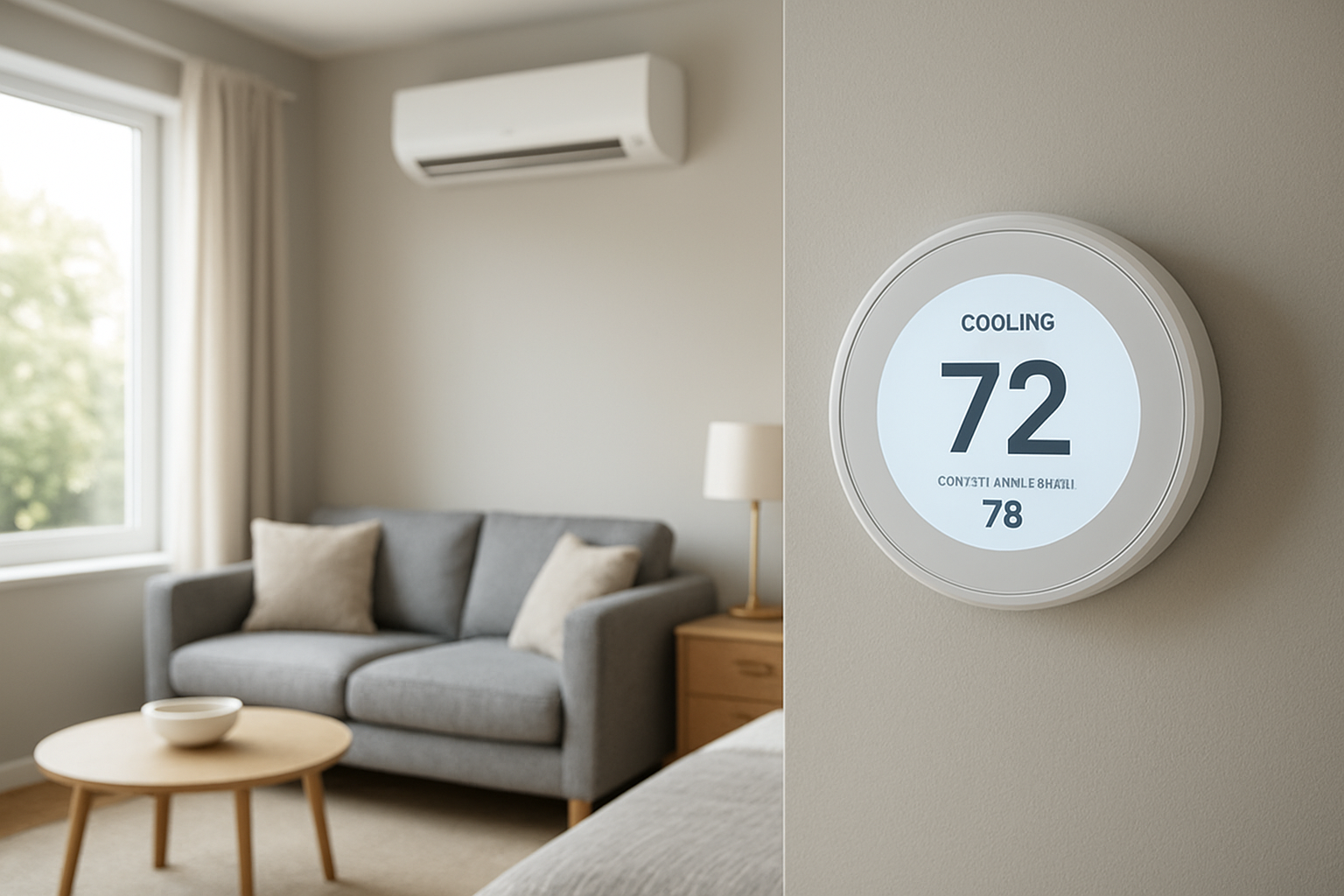
- Check thermostat fan setting: Set the fan to AUTO for a full day. If comfort improves (less clammy, better cool feeling) without other changes, continuous fan mixing and moisture rebound was a major contributor.
- Return-to-supply temperature drop: After the system has been cooling continuously for 15 minutes, compare the air temperature entering the return grille to the air at a nearby supply vent. A noticeably small drop suggests reduced cooling output; a strong drop with poor room comfort suggests distribution or load issues.
- Outdoor unit confirmation: When the indoor fan is blowing and the thermostat is calling for cooling, verify the outdoor unit is running steadily. You should hear the compressor and feel warm air exhausting from the top/side discharge. If the outdoor unit is off while the indoor fan blows, cooling will feel weak by definition.
- Airflow comparison room-to-room: With all supply vents open, compare airflow by feeling at multiple vents. If some are strong and some are weak, suspect duct restriction, a damper issue, or a return pathway problem rather than refrigerant.
- Door test for return air pathways: With the system running, close a bedroom door until it is nearly shut and feel for pressure pulling or pushing at the crack. Strong pressure is a clue the room is being pressurized (supply without return). That reduces delivered airflow and makes cooling feel weak in closed rooms.
- Ice and sweating clues: Look at the larger insulated copper line near the indoor unit or outdoor unit. If you see ice buildup or heavy sweating with poor cooling, that supports airflow restriction or low refrigerant. Do not chip ice; let the system thaw by turning cooling off if icing is visible.
- Time-of-day pattern: If cooling feels acceptable in the morning and weak in late afternoon, note sun-exposed rooms and upstairs areas. That pattern supports solar gain/load or duct heat gain, not just a fan problem.
Normal Behavior vs Real Problem
- Normal: Fan runs during a cooling call and may run slightly after to equalize temperature; slight room-to-room differences; longer runtimes during the hottest part of the day.
- Normal (if intentionally set): Fan runs constantly when set to ON, but the home should not feel persistently clammy or unable to cool unless another issue exists.
- Problem: Fan runs nonstop even when set to AUTO; supply air is only mildly cooler than room air during a long cooling call; humidity feels high and sticky; outdoor unit is not running whenever the thermostat calls for cooling; visible icing on refrigerant lines or at the coil area; airflow noticeably weaker than usual.
When Professional Service Is Needed
- Temperature drop stays low during a 15–20 minute continuous cooling run and the house cannot maintain setpoint under typical summer conditions.
- Outdoor unit behavior is abnormal: short runs, frequent stopping, or no operation during a cooling call while the indoor fan blows.
- Any icing is observed on the refrigerant line, indoor coil area, or outdoor unit piping.
- Fan runs nonstop in AUTO for more than a day after thermostat settings are verified, suggesting a stuck relay, control board issue, or wiring fault.
- Comfort impact is persistent: clammy indoor air, worsening allergies from constant air movement, or large room-to-room temperature differences that do not respond to basic vent/door adjustments.
How to Prevent This in the Future
- Use AUTO fan as the default in humid weather to prevent moisture blow-off and comfort loss, unless a technician has set up a specific circulation strategy.
- Replace filters on a schedule based on dust load, not the calendar alone. If airflow drops or returns whistle, change the filter and re-check vent airflow.
- Keep supply vents open and unobstructed. Closing many vents can raise static pressure and reduce effective airflow and cooling.
- Maintain return air pathways: use transfer grilles, jump ducts, or undercut doors where needed so closed rooms can still return air.
- Reduce peak load where the symptom shows up: manage solar gain with blinds/shades in late afternoon-facing rooms and seal obvious air leaks that drive continuous mixing and heat gain.
- Seasonal professional maintenance: coil cleanliness, blower performance, and refrigerant diagnostics prevent the common scenario of strong fan airflow with weak cooling output.
Related Home Comfort Symptoms
- AC runs but air is not cold from vents
- House feels clammy even at the right temperature
- Upstairs too hot while downstairs is cool
- Some rooms have weak airflow from vents
- Outdoor unit not running but indoor fan is blowing
Conclusion
When the AC fan runs constantly but cooling feels weak, the most common real-world combination is continuous air mixing plus reduced cooling capacity at the coil or poor dehumidification. Start by setting the fan to AUTO and observing humidity feel, then confirm cooling output by comparing return air to supply air after 15 minutes of steady cooling and verifying the outdoor unit runs. If icing appears, temperature drop stays low, or the fan will not stop in AUTO, schedule service.
Frequently Asked Questions
Will running the fan constantly make my AC feel less cold?
Yes. Constant fan operation can make the house feel less cool by re-evaporating moisture off the indoor coil between cooling cycles and by mixing warmer air from hot zones into the living space. It does not reduce the system’s rated capacity by itself, but it can reduce delivered comfort.
If airflow is strong, can I still have a cooling problem?
Yes. Strong airflow with weak cooling usually points to reduced cooling capacity at the coil, such as low refrigerant charge, a dirty coil, or an outdoor unit problem. In that case the fan can move plenty of air, but the air is not being cooled enough.
What if the fan runs nonstop even when set to AUTO?
That is typically a control issue such as a stuck blower relay, control board problem, thermostat wiring fault, or a thermostat problem. It is not normal for the blower to run indefinitely in AUTO when there is no cooling call.
Why does the house feel sticky when the AC is running a lot?
Sticky comfort usually means indoor humidity is staying high. Continuous fan operation can pull moisture back off the indoor coil after the compressor shuts off. Also, if the system is not producing a strong enough temperature drop, it often removes less moisture, increasing that clammy feeling.
Can duct problems cause constant fan with weak cooling?
Yes. Duct leakage, crushed flex duct, closed dampers, or poor return air pathways can make cooling feel weak even when the equipment is operating. The fan may be set to ON to compensate for uneven rooms, but the underlying issue is that the cooled air is not reaching the right spaces effectively.
Need a complete overview? Visit the full troubleshooting guide here: Read the full guide for more causes and fixes.
Nothing tests patience like hearing that fan kick on all day while the air feels like it’s barely trying. When the comfort finally shows up, it’s almost unfair how big a difference a small fix can make.
It’s one of those quiet wins that changes your whole evening routine—windows closed, shoulders down, and that constant hum replaced by the kind of cool you don’t have to chase. And yeah, it’s satisfying to know it was never “normal,” just misbehaving.