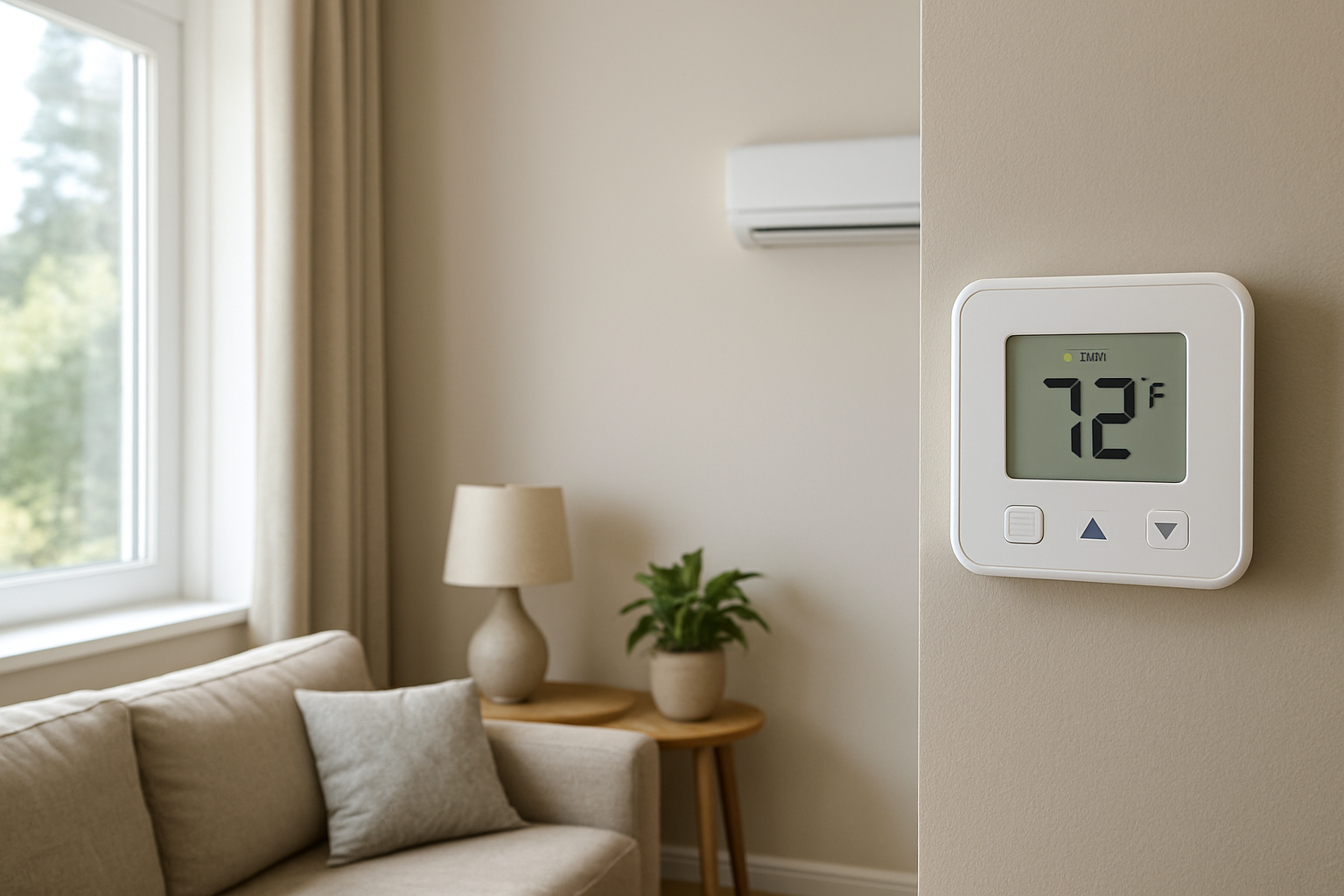
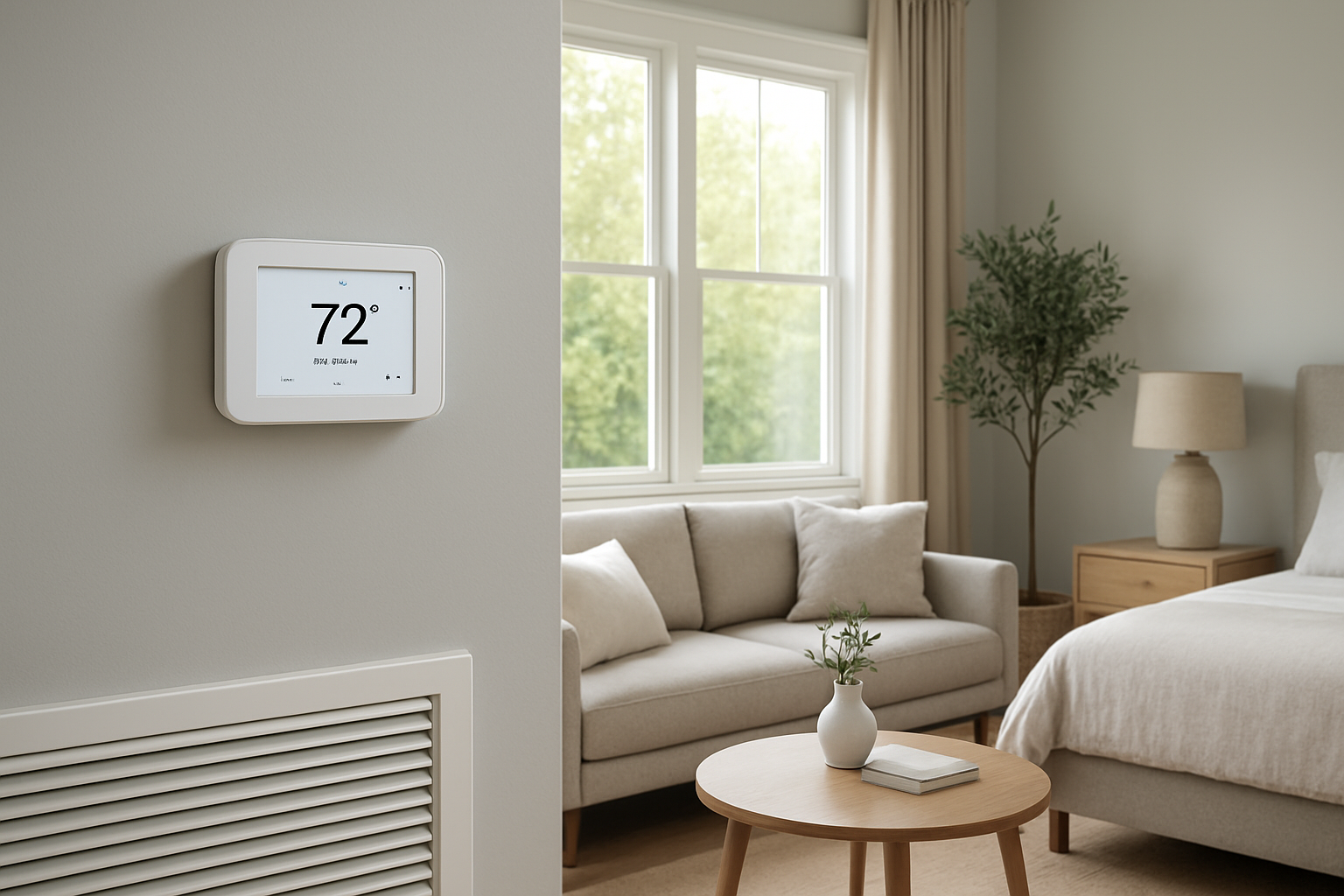
Diagnose and fix thermostat control instability or calibration drift issues causing temperature fluctuations, ensuring your thermostat maintains the set temperature accurately.
Thermostat Won’t Hold Temperature? Control Drift
Quick Answer
If your thermostat won’t hold the set temperature and the room swings or overshoots, the most common cause is thermostat control instability or calibration drift. The first check is to measure the actual room temperature at the thermostat location with a reliable thermometer for 20–30 minutes and compare it to what the thermostat displays while the system is running and after it shuts off.
Identify the Comfort Pattern First
Before blaming the equipment, sort the pattern. Control drift is usually a measurement or control problem at the thermostat, not a true whole-house capacity issue.
When it happens: Does it drift more in the afternoon (sun on the wall), during cooking, or when many people are home? Does it stabilize at night?
Where it happens: Is the discomfort mainly near the thermostat area, or do distant rooms stay steady while the thermostat area swings?
System running vs off: Does the displayed temperature change quickly when the blower starts or stops (minutes, not hours)? That points to sensor influence, not the house warming/cooling naturally.
Constant vs intermittent: Random jumps of 1–3 degrees without matching room feel usually indicate sensor error or airflow influence. Slow, steady changes track real load changes.
Doors open vs closed: If closing a nearby door changes how often the system cycles or how stable the reading is, the thermostat location is being affected by pressure/air mixing, not the average home temperature.
Vertical differences: If the thermostat is on an interior wall but you feel warmer upstairs or cooler at the floor while the thermostat seems stable, that is stratification. If the thermostat reading itself swings while the house feels similar, that is sensor influence.
Humidity perception: In cooling season, if the temperature overshoots cold and the air feels clammy, that suggests short-cycling or oversized cooling driven by unstable thermostat control.
Airflow strength: If supply airflow at nearby registers blasts when the system starts and the thermostat is in that air path, the sensor can be “washed” by supply air and misread the real room temperature.
What This Usually Means Physically
A thermostat controls comfort based on what its sensor thinks the temperature is at that spot. If the sensor is biased or unstable, the system cycles at the wrong times, causing real temperature swings.
Sensor error and thermal coupling: The thermostat sensor is affected by heat from the wall cavity, sunlight, a lamp/TV, drafts from a hallway, or supply air dumping near it. The sensor’s reading shifts faster than the room’s actual average temperature.
Control instability: If cycle rate, temperature swing, or staging settings don’t match your system, the thermostat can overshoot. It may call too aggressively or shut off too early, then re-call, creating oscillation.
Location bias: A thermostat in a hot/cold microclimate (near exterior doors, kitchens, return grilles, or stairwells) responds to that microclimate, not the living space average. The house can feel off even when the thermostat insists it is right.
Calibration drift: Over time, some sensors drift a degree or two. A small offset causes persistent mismatch where the display holds steady, but your comfort does not.
Air mixing effects: Stratification and pressure differences change the air temperature at the thermostat faster than the rest of the home changes, which looks like the thermostat can’t hold temperature even though the equipment is operating normally.
Most Probable Causes (Ranked)
Thermostat influenced by supply air or return air movement: The displayed temperature changes quickly when the blower starts/stops, especially if there is a nearby supply register, return grille, or stairwell draft.
Thermostat location in a microclimate: Setpoint seems “wrong” only at certain times (sun hits that wall, cooking times, exterior door usage). Other rooms may feel steadier than the thermostat area.
Calibration drift or inaccurate sensor: A consistent offset exists between a trusted thermometer and the thermostat reading, even when the system is off and conditions are stable.
Improper control parameters (cycle rate, swing, staging, recovery): System short-cycles or overshoots despite steady loads; temperature swings repeat with a predictable rhythm.
Power or communication instability (smart thermostat or equipment interface): Random temperature display jumps, intermittent rebooting, Wi‑Fi disconnect behavior, or erratic calls without a matching change in room feel.
True load or distribution problem misread as thermostat drift: The thermostat area stabilizes but other rooms drift; doors strongly affect room temperatures; strong floor-to-ceiling differences persist. This is not primary control drift, but it can mimic it.
How to Confirm the Cause Yourself
These checks rely on observation and simple measurement. You are looking for whether the thermostat is reporting the room accurately and controlling smoothly.
Stability test at the thermostat: Place a reliable digital thermometer on a chair or shelf 3–5 feet above the floor and within 2–3 feet of the thermostat (not touching the wall). Let it sit 20–30 minutes. If the thermostat differs by more than about 2°F consistently, calibration drift or location influence is likely.
Blower start/stop influence: Watch the thermostat temperature display as the system starts and after it stops. If it shifts quickly (about 1°F within a few minutes) without the space actually changing that fast, the sensor is being influenced by airflow or wall temperature.
Sun and internal heat check: Compare behavior on a sunny day versus cloudy day, or during cooking versus quiet times. If drift aligns with sun exposure or internal heat, the thermostat location is biased.
Door position check: Keep a nearby door (especially to a hallway, stairwell, or return area) open for an hour, then closed for an hour under similar conditions. If cycling behavior changes noticeably, the thermostat is in an air-mixing pathway and is not reading the average space.
Room-to-room comparison: Walk the home when the thermostat says it is at setpoint. If the thermostat area feels different from adjacent rooms, the thermostat is measuring a local condition. If the whole home is drifting together, the issue may be capacity or outdoor load rather than sensor drift.
Cycle pattern observation: In mild weather, normal systems run longer, steadier cycles. If you see frequent short runs (a few minutes) and quick restarts while the thermostat temperature barely moves, suspect control settings or sensor influence rather than true heating/cooling demand.
Normal Behavior vs Real Problem
Normal: A 1–2°F swing around setpoint in typical homes, especially during weather changes or with strong sun on windows. Short, occasional overshoot can happen with forced-air systems and is often more noticeable in small rooms or open stairwells.
Likely problem: Repeating overshoot/undershoot cycles that you can predict, frequent on/off cycling despite steady weather, or the thermostat display disagreeing with a nearby thermometer by more than about 2°F for extended periods.
Control drift indicators: Temperature display changes faster than the room can physically change, comfort improves when you stand away from the thermostat area, or the issue tracks sunlight, drafts, or blower operation more than outdoor temperature.
When Professional Service Is Needed
Persistent instability: The thermostat reading or comfort swings persist for more than a week across similar weather, after you have confirmed the thermostat is not being hit by direct supply air or sunlight.
Comfort impact: Repeated 3°F or larger swings, sleep disruption, or humidity complaints that appear tied to short-cycling.
Performance decline: Noticeably higher energy use, longer recovery times, or the system frequently starts and stops in short bursts.
Equipment control complexity: Two-stage, modulating, heat pump with aux heat, or zoning systems where incorrect thermostat configuration can cause hunting and overshoot.
Safety indicators: Burning smell, unusual noises at startup/shutdown, or any signs of overheating at the thermostat or wiring. Shut the system off and schedule service.
How to Prevent This in the Future
Protect the thermostat location: Keep it out of direct sun, away from supply registers, exterior doors, kitchens, and stairwells when possible. Avoid lamps or electronics that warm the wall near the thermostat.
Reduce drafts and wall cavity influence: If the thermostat is on an exterior wall or leaky wall cavity, sealing the penetration behind the thermostat can reduce false readings caused by wall temperature and air leakage.
Use appropriate control settings: Ensure cycle rate, temperature swing, and staging are configured for your specific system type. Incorrect settings are a common cause of oscillation after thermostat replacement.
Maintain steady airflow: Keep filters changed on schedule and supply/return vents unobstructed so the system delivers consistent air, reducing rapid local temperature shifts near the thermostat.
Verify after changes: After any thermostat upgrade, HVAC service, or register adjustment, re-check the thermostat vs thermometer match for a day and watch for short-cycling.
Related Home Comfort Symptoms
Short cycling: System turns on and off every few minutes without stabilizing comfort.
Temperature overshoot: Heat runs past setpoint or AC cools too far, then rebounds.
One room controls the whole house poorly: Thermostat room feels different from the rest of the home.
Humidity feels high even at the right temperature: Often linked to short run times caused by unstable control.
Upstairs/downstairs mismatch: Stratification and air mixing issues that can mimic thermostat problems.
Conclusion
When a thermostat won’t hold temperature, the most common root cause is control instability or calibration drift: the thermostat is not reliably sensing the true room condition or it is driving the system with settings that cause hunting. Confirm it by comparing the thermostat reading to a nearby steady thermometer and by watching whether the displayed temperature changes rapidly with blower on/off. If swings are large, frequent, or tied to staging/short-cycling, schedule professional setup and verification.
Frequently Asked Questions
How far off is too far for a thermostat reading?
A consistent difference over about 2°F compared to a reliable thermometer placed near the thermostat (not against the wall) usually warrants calibration adjustment, relocation, or troubleshooting for drafts and airflow influence.
Why does the thermostat change when the fan turns on?
That typically means the sensor is being influenced by moving air or by a temperature gradient at that wall location. Common sources are a nearby supply register, return airflow pulling from a hallway, or air leakage from the wall cavity behind the thermostat.
My thermostat hits setpoint but the house still feels wrong. Is that drift?
It can be, but often it is location bias. The thermostat may be reading a microclimate accurately while other rooms are different due to airflow distribution, stratification, or solar gain. Compare room temperatures and note whether the discomfort is localized or whole-house.
Can thermostat settings cause temperature swing even if the sensor is accurate?
Yes. Incorrect cycle rate, swing, staging, or recovery settings can make the system overshoot and undershoot. This is especially common with heat pumps, two-stage equipment, or after a thermostat replacement where default settings do not match the system.
Should I replace the thermostat immediately?
Not until you confirm the problem follows the thermostat reading rather than room-to-room airflow issues. First rule out sunlight, drafts, and register influence, then verify a consistent offset with a nearby thermometer. If the offset and instability persist under stable conditions, replacement or professional calibration/configuration is reasonable.
Need a complete overview? Visit the full troubleshooting guide here: Read the full guide for more causes and fixes.
Temperature swings are one of those small daily annoyances that don’t look like much until you’re the one adjusting your comfort every few minutes. When the control stops wandering, the room feels like it finally remembers what you asked for.
There’s a quiet relief in that steady hum—no chasing, no side-eye at the thermostat, no second-guessing your sanity. The comfort is boring again, in the best possible way.