Diagnose why a dehumidifier runs quietly but removes little moisture, focusing on low humidity levels or faulty humidity sensor readings affecting performance.
Dehumidifier Runs Quietly But Removes Little Moisture? Here’s The Problem
Quick Answer
If your dehumidifier runs quietly but the water bucket stays nearly empty, the most common reason is there is not much moisture available to remove at that moment or the humidity sensor is reading wrong and shutting the unit down early. First check: compare the unit’s displayed humidity to a separate hygrometer placed next to it for 30 minutes.
Identify the Comfort Pattern First
Before assuming the dehumidifier is failing, sort the pattern. These observations tell you whether you have a low moisture load situation, a sensor misread, or a true capture problem.
When it happens: Little or no water collection during cool, dry weather, after a cold front, or after the HVAC has been running a lot usually points to low moisture load. Poor removal during muggy weather is more suspicious for sensing or air/temperature issues.
Time of day: Better performance late afternoon/evening (warmer indoor air) but weak performance overnight (cooler indoor air) commonly indicates the air is too cool for strong condensate production, or the sensor is ending cycles early.
Where it happens: Basements that feel cool can show low collection even with a running unit because coil temperature and room temperature are marginal. If the same unit collects well upstairs but not in the basement, it is usually an environmental/placement condition, not a sealed-system failure.
System running vs off: If the central AC has been running, indoor RH may already be low, leaving very little for the dehumidifier to do. If RH rises when AC is off but the dehumidifier still doesn’t collect, suspect sensor error or airflow/temperature limitations.
Constant vs intermittent: A unit that cycles on and off frequently with minimal water often has a misreading humidity sensor or is sitting in its own dry discharge air. A unit that runs continuously but still doesn’t collect can be low moisture load, too-low temperature, or inadequate airflow through the machine.
Doors open vs closed: If humidity improves only when the door to the space is closed, you are drying a large connected air volume faster than the unit can keep up, creating the impression of low collection. If closing the door makes the unit collect more, it was previously diluted by air exchange.
Vertical differences: If the floor level feels cooler and damper but the air near the unit feels neutral, you may have stratification and the unit is sampling drier air than the floor zone. This often looks like low collection with persistent musty feel near the slab.
Humidity perception: If the room does not feel humid and windows are not sweating, low moisture load is likely. If you still feel stickiness, get a measured RH reading; perception can be misleading at cooler temperatures.
Airflow strength: Weak discharge airflow compared to past behavior suggests a clogged filter or coil, which can cause low water collection even when humidity is present. Strong airflow with low water more often points to low load or sensor control.
What This Usually Means Physically
A dehumidifier removes moisture by pulling room air across a cold evaporator coil. Water only condenses if the coil is below the air’s dew point. That means moisture removal is driven by three physical conditions:
Moisture load: If the room’s RH is already low, the dew point is low. The coil won’t produce much condensate because there is simply not enough water vapor available. This is common after long AC runtimes, during dry weather, or in spaces with controlled ventilation.
Temperature and dew point: Cooler air holds less moisture. In a cool basement, the air can feel damp at 60–65°F even when the actual moisture content is modest. If the dew point is low enough, the unit may run but produce very little water because the coil-to-dew-point driving force is small.
Sensor interpretation: The built-in humidistat decides when to start/stop. If it reads low (or it is influenced by the unit’s own dry discharge air), it will think the target is met and either cycle early or never enter a strong removal mode. This creates the exact symptom: quiet operation, little bucket water, and no clear improvement in comfort.
In most homes with this complaint, the unit is not broken. The space is either not actually humid at the unit location, or the unit is being told it is not humid due to sensor error or sensor placement effects.
Most Probable Causes (Ranked)
Low actual humidity at the unit location: Independent hygrometer near the unit reads near the setpoint already (typically 45–55% RH), and windows/metal surfaces are not sweating.
Humidity sensor misreading or biased by discharge air: Displayed RH is noticeably lower than a separate hygrometer, or the unit cycles off quickly even though the room hygrometer reads high.
Air in the space is cool enough to limit condensation rate: Basement/room temperature is around low-to-mid 60s°F and the unit produces minimal water unless the air warms up.
Placement/air mixing problem causing the unit to sample the wrong air: Unit is in a corner, near a supply register, dehumidifying its own discharge stream, or blocked by furniture; the area around it is drier than the rest of the space.
Reduced airflow through the dehumidifier: Filter is dirty, intake/exhaust is restricted, or coil is dust-loaded; airflow feels weaker than normal and removal drops even when RH is truly high.
How to Confirm the Cause Yourself
These checks rely on observation and simple measurements. You do not need tools beyond an inexpensive hygrometer.
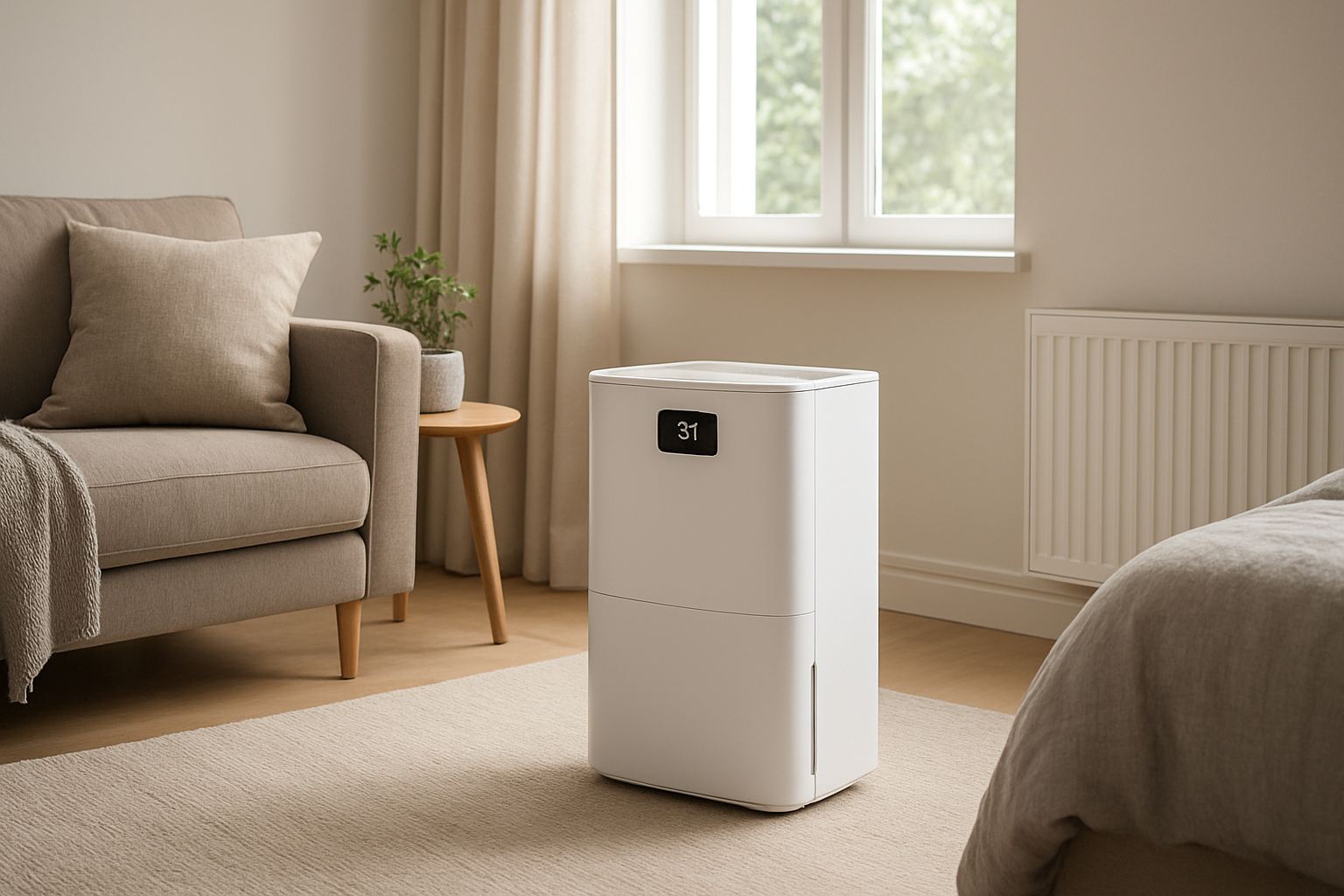
Compare humidity readings: Place a separate hygrometer right next to the dehumidifier air intake (not in front of the discharge). Wait 30 minutes. If the unit display differs by more than about 5% RH, treat the dehumidifier’s sensor/control reading as suspect.
Check dew point effect using temperature and RH: Measure room temperature and RH. If the room is cool (near 60–65°F) and RH is not actually high, the moisture available to condense is limited. A space can feel clammy at low temperature without having a large moisture load.
Bucket reality check over a fixed runtime: Empty the bucket, run the unit continuously (not Auto) for 4 hours with doors and windows closed. If it collects almost nothing and your separate hygrometer stays below about 55% RH, the unit likely has little to remove.
Short-cycle pattern check: Watch one full cycle. If the compressor runs briefly and shuts off repeatedly while your hygrometer still shows high RH, the unit is being told the humidity is low (sensor bias/misread) or it is sampling a dry pocket of air.
Placement test: Move the unit to the center of the humid area and keep at least 12–18 inches clearance on all sides. Keep it away from supply vents, fans, or open stairwells that can dilute reading. If collection improves after relocation, the original location was giving a false low-humidity signal.
Airflow comparison: Compare discharge airflow to what you remember historically. If it feels weaker, inspect the filter for dust loading and confirm the intake/exhaust grilles are not blocked. Reduced airflow commonly looks like normal sound but poor moisture removal.
Normal Behavior vs Real Problem
Normal behavior looks like this: the dehumidifier runs for short periods, the bucket fills slowly, and measured RH stays near the setpoint. In drier weather or when the AC is already dehumidifying, it may run quietly and collect very little water for days while still doing its job.
A real problem is more likely when: measured RH stays above about 60% for multiple days with doors/windows closed, the unit runs many hours, and the bucket remains nearly empty. Another red flag is a consistent mismatch between the unit’s displayed RH and an independent hygrometer, especially if it causes frequent early shutoffs.
When Professional Service Is Needed
Persistent high RH: Independent hygrometer reads above 60% RH for 48–72 hours in the same closed space while the unit runs most of the day and still produces little water.
Control failure signs: The unit will not run in continuous mode, shuts off within minutes despite high measured RH, or the displayed humidity is clearly inaccurate and cannot be corrected by relocation.
Performance decline: You used to collect significant water under similar weather conditions, but output has dropped drastically with no changes in house usage or ventilation.
Safety/abnormal operation: Burning odor, repeated tripping of a breaker, water leakage not associated with a full bucket, or loud mechanical noises.
How to Prevent This in the Future
Verify humidity with your own measurement: Keep a small hygrometer in the space. Set the dehumidifier based on measured RH, not on feel.
Avoid sensor bias from airflow: Place the unit where it draws mixed room air, not its own discharge, and not directly in the path of a supply register or fan.
Keep the space thermally stable: In very cool basements, modest warming or better air mixing can improve dehumidifier effectiveness because condensation potential increases with higher air temperature at the same RH.
Maintain airflow: Keep intake and exhaust clear and clean the filter on a schedule based on dust conditions. Low airflow frequently masquerades as low moisture removal.
Control the moisture at the source: If humidity spikes are seasonal, focus on limiting outdoor air leakage during humid months and managing large moisture events (drying clothes indoors, open shower doors, frequent door-to-outside use in basements).
Related Home Comfort Symptoms
Basement feels damp but hygrometer reads normal
Dehumidifier short cycles and never fills the bucket
Humidity reads different in one corner than the center of the room
Musty odor persists even when RH is 50–55%
AC seems to control temperature but humidity varies widely
Conclusion
A dehumidifier that runs quietly but removes little moisture is most often facing a low moisture load in the air it is sampling or a humidity sensor that is reading low and ending cycles early. Confirm it with a separate hygrometer placed at the intake and a fixed 4-hour run test in a closed space. If measured RH stays above 60% for days with minimal water collected, move from observation to professional evaluation.
Frequently Asked Questions
Why does my dehumidifier say 45% but my hygrometer says 60%?
The dehumidifier sensor is likely miscalibrated or is being influenced by drier air near the unit, commonly from its own discharge stream or a nearby supply vent. Relocate the unit to a more open, mixed-air location and recheck after 30 minutes. If the gap stays over about 5% RH, treat the unit reading as unreliable.
Is it normal for a dehumidifier to run and barely fill the bucket?
Yes, if the actual room humidity is already near the setpoint or the weather is drier. A bucket that fills slowly can still mean the unit is maintaining humidity. What matters is measured RH over time, not bucket volume alone.
Why does it collect more water in summer than winter?
Summer air leakage and higher outdoor dew points create a higher indoor moisture load, so the dehumidifier has more water vapor available to condense. In winter, indoor air often has a lower moisture content (lower dew point), so condensate production drops sharply even if the unit runs.
Can cool basement temperature make the dehumidifier act like it is not working?
Yes. Cool air lowers the moisture content at a given RH and reduces the condensation driving force. The space can feel clammy while not offering much water to condense. If performance improves when the basement warms a few degrees, the limitation is environmental rather than a mechanical failure.
What humidity level should I target to know it is working?
For most lived-in spaces, maintaining about 45–55% RH is a practical range. If your independent hygrometer stays in that range with the dehumidifier cycling normally, low bucket fill is not a problem. If RH stays above 60% despite long runtimes, treat it as a performance or control issue.
Need a complete overview? Visit the full troubleshooting guide here: Read the full guide for more causes and fixes.
It’s easy to mistake quiet for success, especially when the room feels “fine” on the surface. But the lack of lift in daily comfort says otherwise, and the numbers (or the readings pretending to be numbers) don’t always tell the same story.
Call it relief when the mystery clears, even if it’s a little anticlimactic. After all, some problems don’t bang loudly—they just linger in the background, doing their best impression of normal.