Learn how to diagnose and fix temperature swings in your home caused by thermostat overshoot or rapid load changes affecting heating and cooling control.
House Temperature Swings From Too Hot To Too Cold? Control Issue
Quick Answer
Most hot-to-cold temperature swings are caused by thermostat overshoot or a rapid change in the home’s heating/cooling load that the thermostat cannot track smoothly. First check: log the thermostat reading and actual room temperature at 15-minute intervals through one full cycle. If the room keeps drifting 2–4°F past the setpoint after the system shuts off, you have overshoot.
Identify the Comfort Pattern First
Before chasing parts, sort the symptom into the correct pattern. Temperature swings can come from control behavior (thermostat and cycle timing) or from uneven heat delivery. These observations tell you which one you have.
When it happens: Worse on sunny afternoons, windy nights, or during cooking/showering points to rapid load change. Random swings with stable weather points to sensing or control.
Where it happens: Whole-house swing (most rooms feel it) points to thermostat/cycle control. One or two rooms only points to airflow/insulation, not a control overshoot.
System running vs off: If it feels too hot or too cold mostly after the system turns off, that is classic overshoot/undershoot from stored energy and fan timing. If it feels bad while running, look harder at airflow distribution.
Constant vs intermittent: Repeating swings every cycle indicates control hysteresis, oversizing, or poor sensor placement. Intermittent swings tied to sun, wind, doors, or exhaust fans indicate load spikes.
Doors open vs closed: If swings get worse when bedroom doors are closed, you may be pressurizing/depressurizing rooms and changing return-air temperature at the thermostat location.
Vertical differences: If the ceiling stays much warmer than the floor in heating season, or cold air pools in cooling season, stratification can fool the thermostat and exaggerate swings.
Humidity perception: In cooling season, if the air feels clammy right after the AC shuts off and then warms quickly, short run times and coil moisture re-evaporation can amplify perceived swings even when temperature change is modest.
Airflow strength: Strong bursts of hot/cold air followed by long quiet periods indicates short cycling or an oversized system, which commonly creates overshoot.
What This Usually Means Physically
Indoor temperature is not controlled directly by your equipment; it is controlled by the thermostat’s decision timing while the house gains or loses heat. When the thermostat turns the system on, the equipment delivers heat or cooling faster than the house is changing on its own. When it turns off, the house continues to change because energy is still moving.
Thermostat overshoot: The system satisfies the thermostat, shuts off, but the room temperature keeps rising (heating) or keeps dropping (cooling). Causes include stored heat in a furnace/coil and ductwork, fan run-on, thermostat filtering/delay, and a system that delivers capacity too quickly for the space.
Rapid load change: The house suddenly gains heat (solar through windows, cooking, many occupants) or loses heat (wind-driven infiltration, fireplace/exhaust fan use, exterior doors). The thermostat reacts after the change already occurred, so you feel warm then cold as the system catches up and then overshoots in the other direction.
Sensor mismatch: If the thermostat is warmer or cooler than the occupied area (sunlight, exterior wall, supply register blow-by, hallway return draft), it cycles based on the wrong temperature. The living space then swings even if the thermostat display looks steady.
Stratification and mixing: Warm air rises. In heating, the thermostat may be in a well-mixed hallway while occupied zones stratify, then a fan cycle or door opening suddenly mixes air and makes the room feel like it changed quickly.
The key is this: the complaint is about swings, not inability to reach setpoint. That pushes the diagnosis toward control timing and load dynamics, not simply low refrigerant or a “weak” furnace.
Most Probable Causes (Ranked)
1) Thermostat location or sensing error (drafts, sunlight, exterior wall, supply air influence): Clue: swings track with sun on the wall, nearby door use, or the thermostat is near a supply register/return grille and reacts quickly to airflow changes.
2) Equipment oversized for the load (short run times causing overshoot/undershoot): Clue: cycles are short (often under 8–10 minutes in steady weather) and temperature swings are worst in mild weather.
3) Fan run-on, fan cycling, or smart thermostat cycle logic causing extra mixing or “coasting” past setpoint: Clue: temperature continues moving in the same direction for 5–15 minutes after the call ends, especially if the blower keeps running.
4) Rapid load change from solar gain, infiltration, or internal loads: Clue: swings match a predictable event: afternoon sun, windy conditions, fireplace/exhaust fans, showering, cooking, or frequent door openings.
5) Duct temperature lag and thermal mass effects (hot/cold ductwork delivering after shutdown): Clue: supply air stays noticeably warm/cold briefly after the thermostat is satisfied, and the closest rooms to the air handler overshoot most.
6) Stratification and return-air path issues (closed doors, no return, pressure imbalance): Clue: swings are stronger in bedrooms with doors closed; opening doors reduces swings within 15–30 minutes.
How to Confirm the Cause Yourself
Use observation only. Your goal is to prove whether the thermostat is controlling the right temperature and whether the space temperature keeps drifting after the system stops.
Track overshoot with a second thermometer: Place a simple digital thermometer at seating height in the main living area, not near a vent or window. For one hour, record thermostat setpoint, thermostat displayed temperature, and the thermometer temperature every 15 minutes. If the room continues 2°F or more past setpoint after shutdown (up in heating, down in cooling), overshoot is real.
Measure cycle length in steady weather: On a day without big sun/wind changes, time three cycles. If run times are consistently under 8–10 minutes and the system satisfies quickly, oversizing or sensing problems are likely.
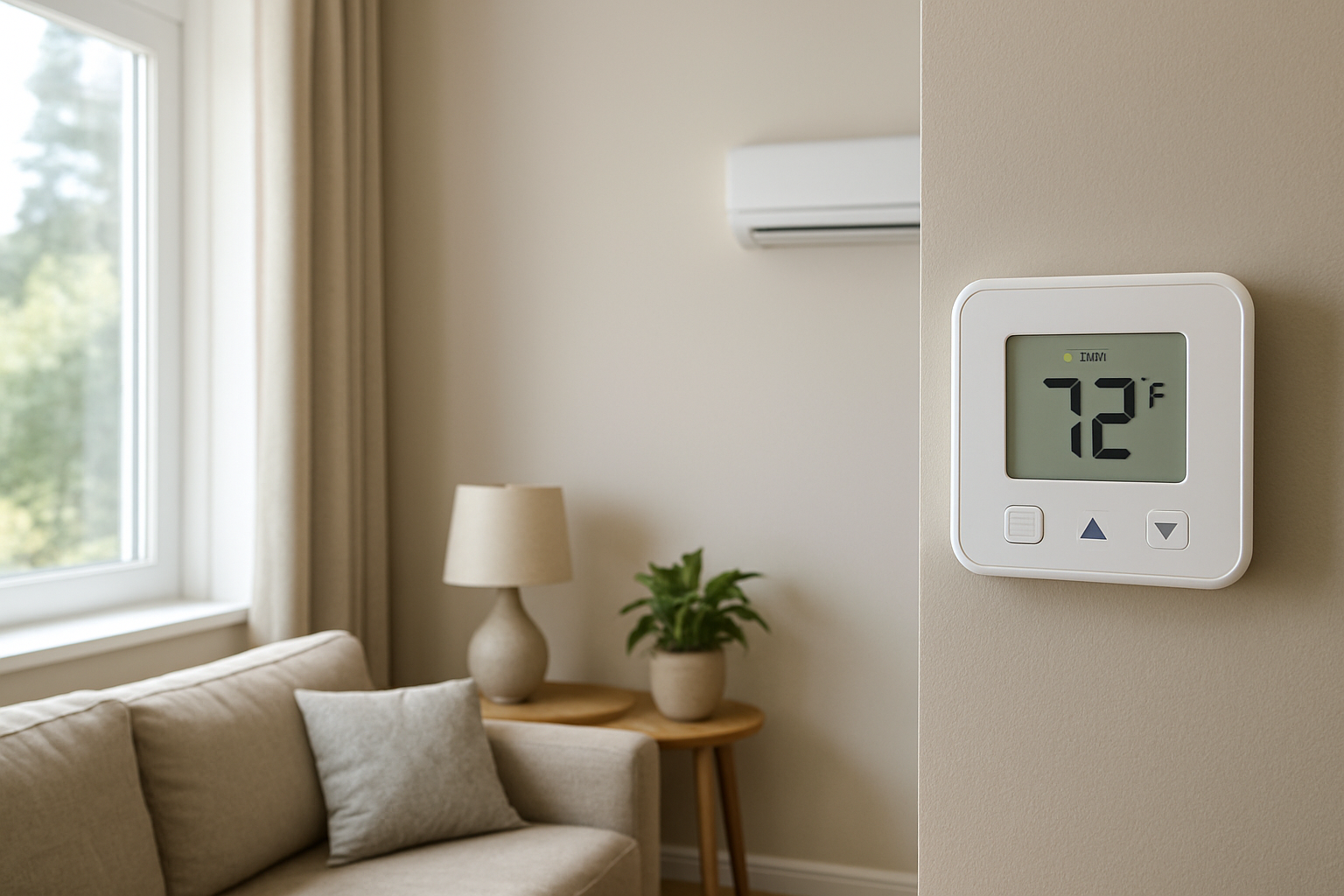
Check thermostat influences: Stand near the thermostat and feel for drafts from nearby returns, supply leakage in the wall cavity, or exterior door drafts. Note whether sunlight touches the thermostat area during the day. If swings align with these, the thermostat is reacting to a local condition.
Fan impact test: If your thermostat allows fan Auto vs On, run one full hour in Auto and observe swing size, then one full hour in On (or any circulating mode) and observe again. If constant circulation makes swings feel worse, you likely have stratification mixing or humidity re-evaporation (cooling season) changing comfort rapidly.
Door position test: For bedrooms or offices, run with doors open for half a day and closed for half a day. If swings increase with doors closed, return-air path or pressure imbalance is amplifying load changes at the thermostat and reducing stable mixing.
Time-of-day and event correlation: Write down what’s happening when the swing starts: sun angle, wind, kitchen use, showers, exhaust fans, fireplace. A repeatable trigger is strong evidence of rapid load change rather than equipment malfunction.
Normal Behavior vs Real Problem
Some variation is normal because houses have thermal mass and weather changes minute to minute. What matters is magnitude, rate, and how often it repeats.
Normal: A slow 1–2°F drift around setpoint, especially during extreme outdoor temperature changes or when doors open frequently. Slight continued movement for a few minutes after shutdown is expected due to residual heat/cool in the coil and ducts.
Likely problem: Repeating swings of 3–5°F or more; discomfort that alternates between too warm and too cool in the same area; short cycles with noticeable bursts; temperature continuing to rise/fall for 10–20 minutes after the call ends; swings that clearly track thermostat location conditions rather than the occupied space.
Control-type signature: The house reaches setpoint easily but cannot stay there without bouncing past it.
When Professional Service Is Needed
Swings persist beyond basic pattern checks: If you confirm 2–4°F overshoot repeatedly in stable weather after trying door and fan tests, a control or sizing correction is needed.
Cycle times are consistently very short: Under 6–8 minutes in steady conditions suggests oversizing, airflow setup issues, or sensor placement problems that require technician instrumentation.
Thermostat placement can’t be corrected easily: If the thermostat is affected by drafts, supply air leakage, or an exterior wall and cannot be improved with simple sealing, relocation or remote sensor setup should be evaluated.
Comfort impact is high in occupied hours: If the swings disrupt sleep, work, or cause frequent manual setpoint changes, the system needs tuning rather than continued adjustments.
Safety indicators: Any furnace odor, soot, unusual burner behavior, or repeated high-limit trips requires immediate professional evaluation (these are not normal control swings).
How to Prevent This in the Future
Stabilize what the thermostat senses: Keep the thermostat out of sun, away from supply air influence, and free of wall cavity drafts. Seal wall penetrations behind the thermostat if accessible and safe.
Use appropriate thermostat features intentionally: Avoid aggressive schedule setbacks if your home is swing-prone, because recovery can overshoot. If available, use remote sensors in the main occupied area rather than a hallway that warms/cools differently.
Reduce rapid load spikes: Manage solar gain with blinds/shades during peak sun; limit long exhaust fan runtimes that pull in outdoor air; use kitchen/bath fans only as needed.
Keep return-air paths consistent: If rooms lack returns, maintain undercut doors or transfer paths so closing doors does not isolate rooms and change pressure and airflow.
Maintain airflow stability: Use the correct filter type and change it on schedule. Severe airflow restriction can change delivered capacity and cause control instability (not just low comfort).
Related Home Comfort Symptoms
Thermostat reaches setpoint but the room keeps getting hotter after heat shuts off
AC shuts off and the house feels warm and sticky within 20 minutes
Short cycling: system turns on and off every 5–10 minutes
One room swings while the rest of the house is stable
Bedrooms uncomfortable when doors are closed
Conclusion
Hot-to-cold swings most often come from thermostat overshoot or a rapid change in heat gain/loss that the control cannot track smoothly. Prove it by logging room temperature through a full cycle and noting how far temperature drifts after shutdown. If overshoot is 2–4°F or cycles are consistently short, focus on thermostat sensing influences, fan run-on behavior, and load triggers before assuming equipment failure.
Frequently Asked Questions
Why does my house feel too hot right after the heat turns off?
Residual heat continues to enter the space after the thermostat is satisfied. The heat exchanger, coil, and ductwork are still hot, and blower run-on can keep delivering heat. If the room rises 2°F or more after shutdown repeatedly, that is overshoot and usually ties to thermostat sensing, fan settings, or an oversized furnace.
Why does it go from cold to hot quickly in mild weather?
Mild weather reduces the home’s load, so an oversized system satisfies the thermostat quickly and shuts off. The space then drifts the other direction until the next call. Short cycles plus noticeable bursts of warm/cool air are the typical signature.
Can a thermostat cause temperature swings even if it reads correctly?
Yes. The display can be accurate at the thermostat while the thermostat is measuring the wrong location for comfort control. Drafts, sun, a nearby supply register, or a return-air stream can make it react faster or slower than the occupied space, creating real comfort swings.
Does running the fan all the time reduce swings or make them worse?
It depends on the cause. Continuous fan can reduce stratification and even out room-to-room differences, but it can also increase perceived swings by mixing warmer ceiling air down (heating season) or re-evaporating moisture from a wet coil (cooling season). The Auto vs On comparison test is a useful clue.
How big of a temperature swing is considered abnormal?
In a stable-weather period, repeated swings of 3–5°F in the same occupied area are not typical for a properly set up system. A consistent 2°F ongoing drift past setpoint after shutdown is enough to justify correcting thermostat sensing, cycle behavior, or sizing/control strategy.
Need a complete overview? Visit the full troubleshooting guide here: Read the full guide for more causes and fixes.
There’s a strange kind of embarrassment that comes with chasing your thermostat around the house like it’s a runaway pet. But when things settle, the whole place feels less like a mood swing and more like a home.
Nothing has to be dramatic for it to be better. Just a little less drama in the air, and the day goes on like it always should have.